

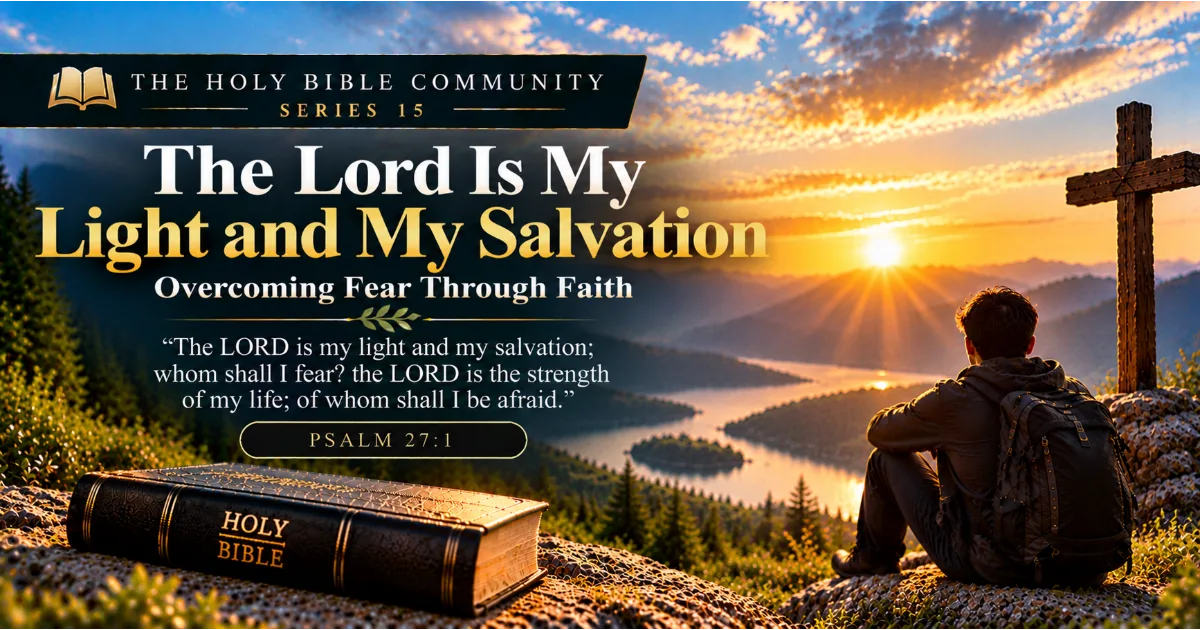
Bible Verse: Psalm 27:1 (KJV)
“The LORD is my light and my salvation; whom shall I fear? the LORD is the strength of my life; of whom shall I be afraid?”
Introduction: Finding Courage When Fear Enters Your Life
Fear is a natural part of the human experience. We feel afraid when we face uncertainty, when someone we love is in danger, when our future seems unclear, or when circumstances threaten the security we have worked hard to build. Sometimes fear appears suddenly in response to an unexpected event. At other times, it grows slowly through repeated disappointments, financial pressure, difficult relationships, or worries about what might happen tomorrow.
Even people who appear confident can experience fear privately. A person may smile in public while worrying about an uncertain future. A parent may remain strong for the family while quietly carrying concerns about their children's wellbeing. Someone pursuing a dream may continue working while wondering whether their efforts will ever produce the desired results.
Fear becomes especially difficult when it begins to control our decisions. We may avoid opportunities because failure seems unbearable, remain silent when we need to speak honestly, or imagine so many possible dangers that taking even a small step becomes difficult.
The Bible does not teach that faithful people never experience fear. Scripture contains many accounts of people who faced danger, uncertainty, grief, and opposition. What distinguishes biblical faith is not the complete absence of fear, but the decision to look toward God in the middle of it.
Psalm 27:1 declares, “The LORD is my light and my salvation; whom shall I fear?” These words express confidence in God's presence, protection, and strength. They remind us that fear does not have to become the final authority over our lives.
This fifteenth post in The Holy Bible Community series explores how Psalm 27:1 encourages believers to face uncertainty with courage, trust God amid difficult circumstances, and make responsible decisions without allowing fear to dominate every part of life.
1. Understanding the Meaning of Psalm 27:1
Psalm 27 is traditionally associated with David, whose life included experiences of danger, opposition, uncertainty, and conflict. Throughout the psalm, the writer expresses confidence in God while also describing a deep desire for God's presence and guidance.
The opening verse begins with three powerful descriptions of the Lord. God is described as light, salvation, and the strength of life. Each image offers a different perspective on why the writer can face fear with confidence.
Light helps us see. In darkness, familiar surroundings may become difficult to understand, and even a simple journey can feel threatening. Light reveals the path, helps us recognize obstacles, and allows us to move with greater clarity. When the Lord is described as light, the image suggests guidance, truth, and the ability to see beyond the confusion created by fear.
Salvation points toward deliverance and rescue. The writer is not claiming that difficulties never occur. Instead, the verse expresses confidence that God is the source of ultimate help and that danger does not have the final word over those who trust Him.
The strength of life describes God as the source of courage and stability. Human strength can become exhausted. Our confidence may weaken when we face repeated disappointments or circumstances beyond our control. The psalm directs attention toward a source of strength greater than our own resources.
The questions “whom shall I fear?” and “of whom shall I be afraid?” are expressions of trust rather than claims that danger is imaginary. The writer recognizes that threats may exist, but refuses to treat them as greater than God.
This distinction is important. Faith does not require us to deny reality. It invites us to view reality through the conviction that fear, danger, and uncertainty are not the only forces at work in our lives.
2. Fear Is Real, but It Does Not Have to Rule You
Fear can serve a useful purpose. It alerts us to possible danger and encourages us to pay attention to situations that require caution. Without the ability to recognize risk, we might make careless decisions or place ourselves and others in unnecessary danger.
However, fear can become overwhelming when it extends beyond a realistic assessment of the situation. We may begin treating every uncertainty as a threat and every setback as proof that something terrible will happen.
For example, a person who has experienced rejection may become afraid of applying for another opportunity. Someone who has been hurt in a relationship may find it difficult to trust anyone again. A person facing financial pressure may spend so much time imagining future difficulties that it becomes harder to make a practical plan.
In these situations, fear is no longer simply warning us about a specific danger. It is beginning to influence our understanding of the entire world.
Psalm 27:1 offers a different foundation. Instead of allowing fear to determine every conclusion, the writer remembers who God is. The focus shifts from the size of the threat to the character of the One in whom the writer trusts.
This does not mean that fear disappears immediately. We may still feel anxious before an important conversation, nervous when starting something unfamiliar, or worried while waiting for a difficult situation to resolve.
Courage often means taking the responsible next step while fear is still present. It may mean seeking medical attention despite being frightened, asking for help when we feel ashamed, speaking honestly when silence seems easier, or continuing a worthwhile effort after disappointment.
Faith can help us resist the belief that we must feel completely fearless before we can act wisely.
We can acknowledge fear without obeying every demand it makes. We can recognize risk without assuming that failure is inevitable. We can ask for help without treating our need for support as weakness.
3. God as Our Light When the Future Is Unclear
One of the most difficult experiences in life is not knowing what lies ahead. We may be able to manage a difficult situation more confidently if we understand how long it will last or what the outcome will be. Uncertainty can be more exhausting than the challenge itself because it leaves us searching for answers.
A person waiting for employment may wonder how long financial pressure will continue. A student may worry about examination results. A family may face an important decision without knowing which option will prove best. Someone going through a relationship difficulty may struggle to understand what the future holds.
When the future is unclear, fear often fills the empty spaces with imagined outcomes. We may repeatedly consider the worst possibilities and begin behaving as though they have already happened.
The image of God as light offers a meaningful response. Light does not necessarily reveal every detail of the distant future, but it helps us see where we are and identify the next step.
In a similar way, Scripture provides principles that can guide our decisions even when the outcome remains uncertain. It teaches the importance of truth, patience, wisdom, justice, compassion, and responsibility.
If you are facing a difficult decision, you may not know exactly what will happen after you choose. Yet you can still ask which option is honest, which responsibilities must be considered, and which choice is consistent with the values you seek to follow.
If you are waiting for an opportunity, you may not know when it will arrive. However, you can continue preparing, improving your abilities, and exploring realistic alternatives.
If you are dealing with a personal conflict, you may not be able to control the other person's response. Still, you can choose to communicate honestly and respectfully.
God's Word can illuminate the choices before us without promising that we will know every detail of tomorrow. Sometimes the most important guidance is not an explanation of the entire future, but the wisdom to take today's step faithfully.
4. God Is Our Salvation When We Feel Vulnerable
The second part of the verse describes the Lord as our salvation. This image reminds believers that they can seek God's help when they feel vulnerable, threatened, or overwhelmed.
Human beings naturally desire security. We want our families to be safe, our work to remain stable, our relationships to be dependable, and our plans to succeed. When these sources of security become uncertain, we may feel exposed and powerless.
The Bible encourages believers to turn toward God in such moments. However, we should understand this teaching carefully. Psalm 27:1 does not guarantee that faithful people will never experience illness, loss, opposition, or other painful circumstances.
Throughout Scripture, people who trusted God still faced serious difficulties. Their faith did not make every threat disappear immediately. Instead, they continued seeking God amid circumstances they could not always control.
Trusting God as our salvation means recognizing Him as the foundation of our hope rather than treating any temporary source of security as absolute.
A job can provide income, but employment can change. Money can help meet important needs, but it cannot prevent every hardship. Relationships can provide companionship, but even loving people have limitations. Our plans can create direction, but unexpected events may require us to adapt.
These things are valuable, yet none can guarantee complete security.
Faith helps us appreciate what we have without demanding that it provide certainty about every aspect of life. It encourages us to act responsibly, prepare for difficulties, and seek help while remembering that our ultimate hope is not limited to our current circumstances.
When you feel vulnerable, pray honestly, consult trustworthy people, and take practical steps to protect your wellbeing. If danger is present, seek appropriate assistance. Trusting God does not require ignoring real threats or refusing help.
The message is that vulnerability need not lead to hopelessness. You can acknowledge your limitations and still seek strength, wisdom, and support as you move forward.
5. The Lord Is the Strength of Your Life
The third image in Psalm 27:1 describes the Lord as “the strength of my life.” This is especially meaningful when we reach the limits of our own energy.
There are times when we feel capable of handling our responsibilities. We have enough confidence to make decisions, enough energy to work toward our goals, and enough emotional strength to support the people around us.
At other times, life becomes more demanding. We may face several problems at once, experience repeated disappointment, or carry responsibilities that seem larger than our resources.
During these seasons, it is easy to believe that we must appear strong at all times. We may hide our struggles because we fear being judged, or refuse to ask for help because we think it will make us seem incapable.
Yet acknowledging our limitations can be an important part of wisdom. No person has unlimited energy, knowledge, or emotional capacity. Recognizing this does not make us failures. It helps us understand when we need rest, support, or a different approach.
The biblical image of God as strength reminds believers that they do not have to depend entirely on their own ability. Through prayer, Scripture, community, and wise action, they can seek the strength needed to face the responsibilities before them.
Sometimes strength means continuing with courage. At other times, it means accepting help, resting when exhausted, admitting a mistake, or stepping away from a harmful situation.
Strength is not always visible as dramatic achievement. It may be reflected in a person who continues caring for a family during a difficult season, chooses honesty despite pressure, or seeks help rather than allowing a problem to grow worse.
When you feel weak, do not assume that your weakness defines your future. Consider what support is available, what responsibilities require attention, and what practical steps can help you regain stability.
Faith can encourage perseverance without demanding that we pretend to be invulnerable.
6. Remembering God's Faithfulness During Past Difficulties
Fear often focuses our attention on what might go wrong. We may become so concerned about future problems that we forget the difficulties we have already survived.
Reflecting on past experiences can help us gain perspective. We may remember a season when we felt overwhelmed but eventually found a way forward. We may recall people who supported us, lessons we learned through disappointment, or decisions that helped us recover from a difficult situation.
These memories do not guarantee that every future challenge will have the same outcome. Nor should we assume that every difficulty will resolve in the way we prefer. However, remembering previous experiences can remind us that the present moment is not the whole of our story.
The Bible frequently encourages God's people to remember His faithfulness. Recalling what God has done becomes a way of strengthening trust during uncertainty.
For Christians, this remembrance can include reflecting on biblical accounts of God's care, reviewing prayers and experiences from previous seasons, and recognizing the support received through other people.
It can also involve acknowledging our own growth. Perhaps we have become more patient, more careful with decisions, more understanding of others, or more willing to seek help.
Fear may tell us that we cannot face another difficulty. Reflection can help us see that we have developed skills and understanding through previous experiences.
This is not an invitation to rely only on past success. Every situation deserves careful attention, and some challenges require new forms of support. Rather, remembrance helps us approach the future with a broader perspective.
You have a history that includes more than your disappointments. There may be lessons, relationships, moments of courage, and experiences of unexpected help that deserve to be remembered.
Taking time to reflect on these things can help you face today's uncertainty without allowing fear to erase everything you have learned.
7. Do Not Allow Fear to Make Your Decisions for You
Fear can influence our choices in ways that are difficult to recognize. Sometimes it encourages us to avoid situations that are genuinely dangerous. At other times, it prevents us from doing something worthwhile simply because the outcome is uncertain.
A person may remain in an unsatisfying situation because change feels frightening. Someone may avoid an important conversation because they fear disagreement. Another person may reject an opportunity because the possibility of failure feels more painful than the possibility of never trying.
These decisions may provide temporary relief, but avoidance can also create long-term difficulties.
Psalm 27:1 encourages believers to remember God's presence and strength when considering what to do. It does not mean that every risk should be taken or every fear ignored. Instead, it invites us to distinguish between reasonable caution and fear that unnecessarily limits our lives.
Before making a decision, identify the actual risks. Gather information rather than relying entirely on assumptions. Consider the possible benefits and consequences. Seek advice from people who understand the situation and have your interests at heart.
Then ask whether your hesitation is based on a genuine danger, a responsibility that needs more preparation, or a fear of discomfort and uncertainty.
For example, starting a business may involve financial risks that deserve careful planning. Courage does not mean investing money recklessly. It may mean conducting research, testing an idea on a small scale, and making an informed decision.
Speaking honestly about a problem may involve emotional discomfort. Courage does not require an aggressive confrontation. It may mean choosing a respectful time and explaining the concern clearly.
Faith and careful judgment belong together. We can be courageous without being careless, and we can acknowledge fear without allowing it to control every choice.
The aim is not to eliminate all uncertainty before acting. It is to make thoughtful decisions based on truth, wisdom, responsibility, and trust.
8. Courage Does Not Mean You Never Feel Afraid
Many people misunderstand courage because they imagine that courageous individuals never feel nervous or uncertain. This belief can make ordinary fear feel like a personal failure.
Yet courage is often most visible precisely when a person has something to fear.
A student may feel anxious before an examination but continue preparing. A parent may feel uncertain about a difficult decision but seek advice and act responsibly. A person who has been treated unfairly may feel afraid to speak up but still choose an appropriate way to address the issue.
In each case, courage is not the absence of discomfort. It is the willingness to act according to what is right and necessary despite that discomfort.
The Bible contains many examples of people who faced intimidating circumstances while relying on God. Their stories do not suggest that every person was naturally confident or that every situation became easy. They show that faith can coexist with vulnerability.
When fear arises, begin by acknowledging it honestly. Ask what specifically worries you and whether the concern requires preparation, practical support, or a change in your plan.
If the situation is manageable, consider taking one small step rather than demanding that you feel completely confident first. If the challenge is beyond your current capacity, seek help rather than attempting to face it alone.
You may need to repeat this process many times. Courage can develop through practice as we learn to respond more thoughtfully to difficult situations.
It is also important to recognize that persistent or overwhelming fear may require professional support. Seeking help is a responsible way to care for yourself, not a sign that your faith is insufficient.
Psalm 27:1 offers encouragement to remember God's strength while facing life honestly. It does not require us to become people who never feel afraid. It invites us to become people who are not governed entirely by fear.
9. Finding Peace When Other People Oppose You
One of the most painful sources of fear is opposition from other people. We may worry about criticism, rejection, conflict, unfair treatment, or the possibility that someone will misunderstand our intentions.
The desire to be accepted is natural. Human relationships matter, and most people want to be treated fairly. However, the need for approval can become overwhelming when we allow other people's opinions to determine our entire sense of worth.
We may begin hiding our convictions, agreeing with things we do not believe, or abandoning important responsibilities because we fear disappointing someone.
Psalm 27:1 reminds believers to place their confidence in God rather than allowing human opposition to become the ultimate measure of their lives.
This does not mean that criticism should always be ignored. Sometimes other people identify genuine mistakes that we need to correct. Humility requires us to listen carefully, examine the facts, and accept responsibility when we are wrong.
However, not every criticism is accurate, and not every person will agree with our decisions. We must learn to distinguish constructive feedback from insults, manipulation, and unreasonable expectations.
When facing disagreement, remain willing to listen while also maintaining appropriate boundaries. Explain your position respectfully, seek common ground where possible, and avoid escalating every conflict into a personal battle.
If the situation involves harassment, threats, or abuse, seek appropriate support and take steps to protect yourself.
Peace does not require universal approval. It comes partly from learning to act with integrity even when our choices are not understood by everyone.
We can respect other people without surrendering every conviction, and we can correct our mistakes without treating every criticism as proof of our failure.
10. Faith Should Lead to Wise Action, Not Recklessness
The confidence expressed in Psalm 27:1 is rooted in trust in God. It should not be interpreted as permission to ignore danger, make careless choices, or assume that harmful consequences cannot occur.
For example, trusting God does not mean refusing medical treatment when it is needed. It does not mean entering a dangerous situation unnecessarily or ignoring credible warnings. It does not mean spending money recklessly because we assume that everything will work out.
Faith should encourage wisdom, not replace it.
The Bible values prudence and discernment. A person who trusts God can still examine evidence, prepare for possible difficulties, ask questions, and make decisions based on sound judgment.
If you are considering a major financial commitment, review the costs and risks carefully. If you are facing a health concern, seek appropriate medical advice. If you are dealing with a serious conflict, consider the safest and most constructive way to respond.
Prayer can help us seek wisdom and examine our motives. Scripture can provide moral principles for evaluating choices. Trusted people may offer experience and perspective that we do not possess.
These resources can work together.
It is also important to recognize that sometimes the wisest decision involves changing direction. Perseverance is valuable, but it does not require continuing a plan that has become harmful or unrealistic.
Courage may mean moving forward, but it may also mean stepping back, asking for help, or admitting that more preparation is needed.
The purpose of biblical confidence is not to make us careless about the realities of life. It is to help us face those realities with faith, humility, and responsible action.
11. Practical Ways to Apply Psalm 27:1 in Everyday Life
Psalm 27:1 can become more than a verse we read during difficult moments. Its message can shape how we approach ordinary decisions and responsibilities.
Begin by identifying the fear that is most present in your life right now. It may concern your future, your family, your work, your finances, your health, or a relationship. Naming the concern can help you understand what you are actually facing.
Next, distinguish between facts and assumptions. What do you know for certain? What are you imagining might happen? What information could help you make a more informed decision?
Then consider what is within your control. You may be able to prepare, communicate, seek advice, set a boundary, or ask for assistance. Write down one practical step you can take instead of allowing the concern to remain an endless cycle of thoughts.
Spend time with Scripture. Read Psalm 27 slowly and reflect on the descriptions of God as light, salvation, and strength. Consider how these images might influence your response to the situation.
Pray honestly. Ask for courage, discernment, patience, and the ability to recognize what needs to be done. You do not need to hide your fear or pretend that you already know the answer.
Take care of your physical and emotional wellbeing. Rest, regular routines, supportive relationships, and appropriate professional assistance can help you respond to stress more effectively.
Finally, review your decisions with humility. If new information changes the situation, be willing to adapt. If you make a mistake, acknowledge it and learn from it.
These practices cannot guarantee that every problem will disappear. Their purpose is to help you respond with greater wisdom and steadiness.
Faith grows through repeated choices. Each time we choose truth over panic, thoughtful action over impulsive reaction, or appropriate support over isolation, we practise a more responsible response to fear.
12. A Prayer for Courage and Freedom from Fear
Heavenly Father, thank You for reminding me through Your Word that You are my light, my salvation, and the strength of my life. When fear begins to overwhelm my thoughts, help me remember that I do not have to face every difficulty through my own strength alone.
Give me wisdom to understand the situations before me. Help me recognize genuine dangers, prepare responsibly, and avoid allowing imagined outcomes to control my decisions.
When the future feels uncertain, guide me toward the next wise step. When I feel weak, remind me that seeking help is not a failure. When I face criticism or opposition, give me humility to accept correction and courage to remain faithful to what is right.
Protect my heart from bitterness, panic, and the desire to control every outcome. Help me respond to others with patience and honesty, even when conversations are difficult.
Teach me to distinguish between courage and recklessness. Give me the discernment to know when to move forward, when to pause, when to change direction, and when to seek support.
When I remember past disappointments, help me learn from them without allowing them to define every future possibility. When I feel anxious, help me pray honestly and take practical steps toward resolving what I can.
May Your Word remind me that fear does not have to become the ruler of my life. Help me walk with faith, humility, and confidence in Your presence.
In Jesus' name, Amen.
Conclusion: Let Faith Be Greater Than Your Fear
Psalm 27:1 offers a powerful reminder for every season of uncertainty: “The LORD is my light and my salvation; whom shall I fear?”
These words do not deny that danger, disappointment, or uncertainty exist. They remind believers that such experiences do not have to become the final authority over their lives.
God is described as light because He provides guidance, salvation because He is the source of deliverance, and strength because human ability has limitations. These images encourage us to look beyond our fears and remember the foundation of our faith.
There may be situations you cannot resolve immediately. You may face decisions that require courage, relationships that require wisdom, or responsibilities that feel larger than your current strength. You may still experience fear even after praying and seeking guidance.
That does not mean you have failed.
A faithful response begins by acknowledging reality, seeking wisdom, and taking the next responsible step. Sometimes courage means continuing. Sometimes it means asking for help. Sometimes it means changing direction or establishing a boundary.
Whatever your circumstances, remember that you do not need to wait until every fear disappears before you begin living with faith.
Remember: Courage is not the absence of fear. It is the willingness to seek God's guidance, act wisely, and continue doing what is right even when uncertainty remains.
May Psalm 27:1 encourage you whenever fear grows strong. Let God's Word guide your decisions, let prayer strengthen your heart, and let wisdom direct your actions. Face each day with humility and hope, remembering that fear may be part of your experience, but it does not have to determine the direction of your life.
#TheHolyBible #HolyBibleCommunity #Psalm271 #FearNot #FaithOverFear #TrustInGod #GodIsMyStrength #ChristianLiving #BibleVerse #DailyDevotion #BiblicalWisdom #CourageThroughFaith #GodsProtection #Prayer #SpiritualGrowth