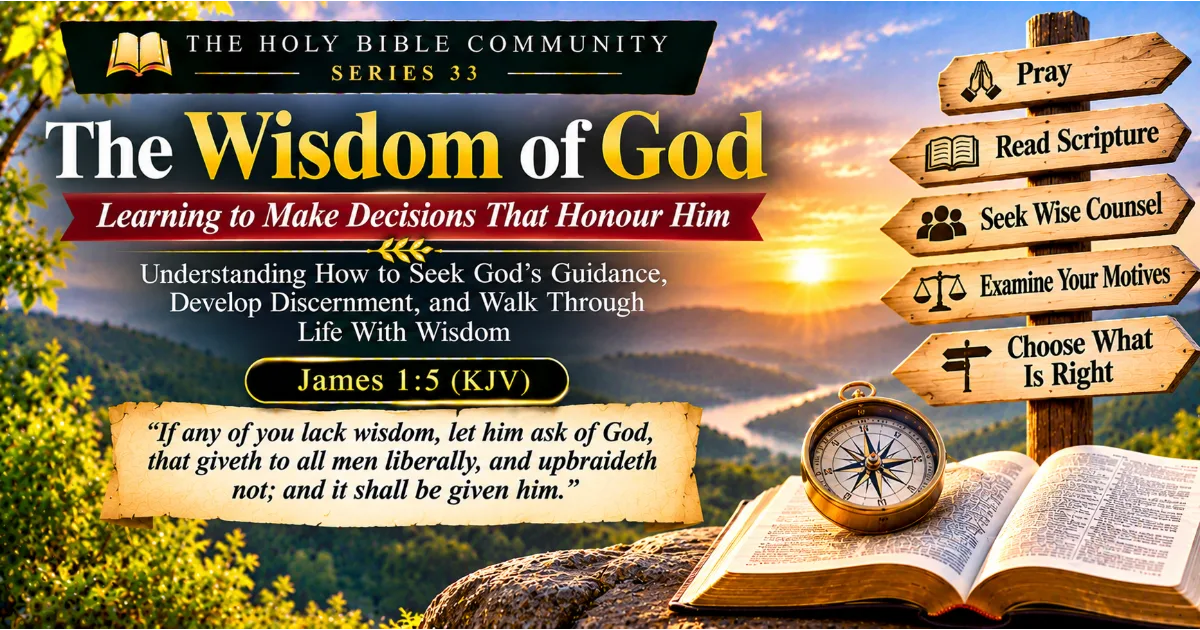
Understanding How to Seek God's Guidance, Develop Discernment, and Walk Through Life With Wisdom
Bible Verse: James 1:5 (KJV)
“If any of you lack wisdom, let him ask of God, that giveth to all men liberally, and upbraideth not; and it shall be given him.”
The Importance of Seeking God's Wisdom
Life is filled with decisions. Some choices appear small and ordinary, while others can influence our families, careers, relationships, finances, responsibilities, and future. Every day, we make decisions about how to use our time, how to respond to people, how to handle disagreements, what opportunities to pursue, and which responsibilities deserve our attention. Although experience and knowledge can help us make these choices, there are moments when we realise that human understanding alone is not enough.
Continue Reading
We may face a situation in which two options appear equally reasonable. We may have to make an important decision without knowing what the future holds. We may receive advice from different people, each presenting a convincing argument. Sometimes, our emotions encourage us to act quickly, while our conscience tells us to pause and think carefully. At such moments, the need for wisdom becomes clear.
The Bible teaches that wisdom is more than intelligence, education, information, or professional experience. A person may possess extensive knowledge and still make decisions that harm relationships, damage character, or lead to unnecessary difficulties. Wisdom involves understanding how to apply knowledge correctly, recognising what is right, considering the consequences of our actions, and choosing a path that honours God.
James 1:5 offers a beautiful invitation to anyone who recognises a need for wisdom. It says that if anyone lacks wisdom, they should ask God, who gives generously and does not rebuke those who seek Him. This verse reminds us that we do not have to pretend to understand everything. We can acknowledge our limitations and approach God with sincerity.
Seeking God's wisdom is not an admission of failure. It is an expression of humility and faith. It means recognising that our perspective is limited and that we need guidance beyond our own understanding.
This message is important for every stage of life. Students need wisdom when choosing their educational paths. Parents need wisdom when raising children and managing family responsibilities. Professionals need wisdom when handling workplace challenges. Business owners need wisdom when making decisions that affect employees, customers, and partners. Young people need wisdom when navigating friendships and opportunities, while older people may need wisdom when guiding others and adapting to changing circumstances.
Whatever our responsibilities may be, God's wisdom can help us develop better judgement, stronger character, and a clearer sense of purpose.
Understanding the Biblical Meaning of Wisdom
Wisdom in the Bible is not simply the ability to collect information or solve complicated problems. It involves living with understanding, discernment, righteousness, and reverence for God.
Knowledge helps us understand facts. Intelligence helps us analyse information. Experience teaches us lessons through events and responsibilities. Wisdom helps us use what we know in a way that reflects truth, goodness, and sound judgement.
For example, a person may know that speaking angrily can damage a relationship. However, wisdom helps that person recognise when to remain silent, when to explain a concern, when to apologise, and when a difficult conversation is necessary.
Someone may understand how to earn money but still struggle to manage it responsibly. Wisdom helps distinguish between genuine needs, unnecessary desires, long-term responsibilities, and temporary attractions.
A person may have the ability to lead a team but lack the wisdom to listen to others, acknowledge mistakes, or treat people fairly. Knowledge and ability may create opportunities, but wisdom helps us use those opportunities responsibly.
The Bible repeatedly connects wisdom with the way people live. It encourages believers to seek understanding, avoid foolish decisions, practise humility, speak carefully, and choose righteousness.
True wisdom is not measured only by how much a person knows. It is also reflected in how that knowledge influences their behaviour.
James 1:5: An Invitation to Ask God for Wisdom
James 1:5 appears in a passage that discusses trials, endurance, and spiritual maturity. James encourages believers to respond to difficult experiences with faith and perseverance. He recognises that trials can create uncertainty and that people may struggle to understand how they should respond.
Within this context, the instruction to ask God for wisdom is especially meaningful. James is not merely encouraging people to seek information. He is teaching them to approach God for the understanding needed to face difficulties faithfully.
The verse begins with the words, "If any of you lack wisdom." This statement acknowledges a reality that everyone experiences. There are times when we do not know what to do. We may feel uncertain, confused, or unprepared. Instead of hiding that uncertainty, Scripture encourages us to recognise it and seek help.
The verse continues by saying, "let him ask of God." This directs our attention toward the source of wisdom. We are encouraged to approach God through sincere prayer rather than relying entirely on our own assumptions.
James then describes God as One who gives liberally. This presents a picture of divine generosity. God is not portrayed as someone who reluctantly responds to those who seek wisdom. He welcomes sincere requests.
Finally, the verse says that God "upbraideth not." In other words, He does not rebuke or humiliate those who ask Him. This is an encouraging reminder for anyone who feels embarrassed about not knowing what to do.
We do not need to approach God pretending to be wise already. We can come honestly, acknowledge our limitations, and ask for guidance.
Why Human Understanding Alone Is Not Enough
Human understanding is valuable, but it has limitations. We see only part of a situation, and our judgement can be influenced by emotions, personal interests, incomplete information, fear, pride, and social pressure.
Sometimes we make decisions based on what appears beneficial in the present without considering the long-term consequences. At other times, we allow temporary anger or disappointment to influence choices that may affect us for years.
A person who feels hurt may want to respond immediately with harsh words. A person who is excited about an opportunity may ignore important risks. Someone who fears failure may reject a good opportunity simply because it involves uncertainty.
These reactions are understandable, but they may not lead to wise decisions.
Seeking God's wisdom encourages us to pause and examine our motives. Instead of asking only what we want, we learn to consider what is right. Instead of focusing entirely on immediate benefits, we consider the consequences for ourselves and others.
This does not mean that human reasoning should be abandoned. God has given people the ability to think, learn, evaluate information, and seek advice. Wisdom involves using these abilities responsibly while recognising that they are not the ultimate authority for our lives.
A wise believer does not reject knowledge or experience. Rather, they seek to bring their understanding into alignment with God's truth.
The Difference Between Wisdom and Intelligence
Intelligence and wisdom are often treated as though they mean the same thing, but they are different.
Intelligence may help someone understand complex ideas, learn quickly, solve technical problems, or analyse information. Wisdom involves knowing how to apply understanding in a way that produces good and responsible outcomes.
A highly intelligent person may know how to win an argument but lack the wisdom to recognise when an argument is unnecessary. Someone may have excellent financial knowledge but still make selfish or irresponsible decisions. A talented leader may understand business strategy but fail to recognise the importance of fairness and compassion.
Wisdom asks questions that go beyond ability. Is this decision honest? Will it harm someone unnecessarily? Am I acting from pride or genuine responsibility? Have I considered the consequences? Does this choice reflect the values I claim to believe?
The Bible encourages believers to seek this deeper understanding. It teaches that a life guided by God should reflect more than intellectual ability. It should demonstrate humility, self-control, righteousness, and concern for others.
The Fear of the Lord Is the Beginning of Wisdom
Proverbs 9:10 (KJV) says:
“The fear of the LORD is the beginning of wisdom: and the knowledge of the holy is understanding.”
The fear of the Lord does not mean living in constant terror of God. In biblical language, it includes reverence, respect, humility, and recognition of His authority.
When we understand that God is holy and that His truth deserves our respect, our approach to life begins to change. We become less willing to treat our personal desires as the highest authority.
Reverence for God encourages us to consider His teachings before making important decisions. It reminds us that our actions have moral significance and that we are responsible for how we treat other people.
For example, a business decision should not be evaluated only by its financial benefit. It should also be considered in terms of honesty, fairness, and its impact on others. A personal relationship should not be judged only by how much happiness it provides. Respect, commitment, trust, and responsibility also matter.
When reverence for God becomes the foundation of our choices, we begin to understand that wisdom is not simply about achieving our preferred outcomes. It is about living in a way that honours Him.
Wisdom Helps Us Make Decisions During Uncertainty
One of the most difficult parts of life is making decisions when the future is unclear. We may have to choose a career path without knowing exactly where it will lead. We may need to decide whether to accept a new responsibility, move to another place, begin a business, or change an existing plan.
Uncertainty can create fear. We may worry about making the wrong choice or losing an opportunity. Sometimes, the fear of regret becomes so strong that we avoid making any decision at all.
God's wisdom helps us approach uncertainty with a balanced mind. It encourages us to seek guidance, examine available information, consider our responsibilities, and avoid decisions driven entirely by fear or excitement.
Seeking wisdom does not mean that every decision will come with a clear sign or an immediate answer. Sometimes we must use the understanding available to us, seek appropriate advice, pray sincerely, and make a responsible choice.
We may not know every detail of the future, but we can still make decisions based on truth, integrity, and careful judgement.
A wise decision is not necessarily one that guarantees an easy outcome. It is one made with sincere motives, responsible consideration, and a willingness to follow what is right.
Wisdom in Our Words and Conversations
Our words have the power to encourage, comfort, teach, damage, divide, and restore. A careless sentence can hurt someone deeply, while a thoughtful response can prevent unnecessary conflict.
The Bible places great importance on the way we speak. Wisdom includes knowing when to speak, what to say, how to say it, and when silence is more appropriate.
When we are angry, we may feel that we must respond immediately. We may want to prove that we are right or make another person understand how deeply they have hurt us. However, a reaction made in anger can create consequences that remain long after the emotion has passed.
Wisdom encourages us to pause. It helps us distinguish between expressing a genuine concern and attacking another person's character.
This does not mean avoiding difficult conversations. Sometimes honesty requires us to speak clearly about a problem. However, we can communicate truth without unnecessary cruelty.
Wisdom also teaches us to listen. Many conflicts become worse because people focus only on defending their own positions. When we listen carefully, we may understand details that we had previously overlooked.
Before speaking, we can ask ourselves whether our words are truthful, necessary, respectful, and helpful. This simple practice can improve relationships at home, at work, and within our wider communities.
Wisdom in Family Life and Parenting
Family responsibilities require patience, understanding, and thoughtful decisions. Parents make choices that influence the emotional, educational, and moral development of their children. Spouses must learn to communicate, manage disagreements, share responsibilities, and support one another through changing circumstances.
Wisdom helps parents understand that children need more than instructions. They also need attention, encouragement, consistency, affection, and good examples.
A parent may become frustrated when a child makes mistakes, but wisdom encourages correction without unnecessary humiliation. It recognises that children learn through guidance, experience, and repeated instruction.
Wisdom also helps parents balance protection with independence. Children need boundaries, but they also need opportunities to develop judgement and responsibility.
Within marriage, wisdom encourages mutual respect and thoughtful communication. It reminds partners that winning every disagreement is less important than building a relationship based on trust, honesty, and care.
Family life is not free from difficulties. Differences in personality, expectations, finances, and responsibilities can create tension. Seeking God's wisdom can help families respond to these challenges with greater patience and understanding.
Wisdom in Career and Professional Responsibilities
Work is an important part of life for many people. It provides opportunities to develop skills, support families, serve customers, contribute to society, and fulfil responsibilities.
However, professional life can also involve difficult choices. We may face pressure to compromise our values, participate in unfair practices, compete dishonestly, or pursue success at the expense of others.
Wisdom helps us understand that professional achievement should not come at the cost of integrity.
An employee may be tempted to take credit for another person's work. A manager may face pressure to treat some employees unfairly. A business owner may have to choose between short-term profit and honest treatment of customers.
In these situations, wisdom encourages us to consider more than immediate personal benefit. It reminds us that our work should reflect responsibility, fairness, and honesty.
Wisdom also helps us respond to criticism. Instead of treating every correction as an attack, we can examine whether there is something valuable to learn. At the same time, we can recognise unfair criticism without allowing it to destroy our confidence.
A wise professional remains willing to learn, accepts responsibility for mistakes, respects colleagues, and understands that leadership involves service as well as authority.
Wisdom in Financial Decisions
Money can influence many aspects of life. It can support families, provide education, create opportunities, and help people respond to emergencies. However, financial decisions can also become sources of stress when they are made without careful thought.
The Bible encourages responsible stewardship. This means recognising that our resources should be managed with honesty, discipline, gratitude, and consideration for others.
Wisdom helps us distinguish between needs and desires. It encourages us to think carefully before borrowing money, making large purchases, investing, or accepting financial commitments.
A person may feel pressure to purchase something simply because others own it. Another may take unnecessary financial risks because of the promise of quick returns. Someone else may spend without considering future responsibilities.
Wisdom encourages patience and planning. It helps us understand that financial decisions should be based on realistic circumstances rather than comparison or temporary excitement.
It also reminds us that money is not the measure of a person's worth. Wealth should not become a reason for arrogance, and financial difficulty should not become a reason to treat ourselves or others without dignity.
A wise approach to money includes meeting responsibilities, avoiding dishonesty, planning for future needs, and helping others when we are able.
Wisdom When Choosing Friends and Relationships
Relationships can influence our attitudes, decisions, habits, and priorities. The people with whom we spend time may encourage us toward responsibility and growth, or they may influence us toward harmful choices.
Wisdom helps us understand that friendship should not be based only on popularity, convenience, or temporary enjoyment. Trust, respect, honesty, and mutual encouragement are important foundations.
A wise person does not judge others only by appearance, wealth, influence, or social position. They pay attention to character and behaviour.
Wisdom also teaches us to recognise unhealthy relationships. Constant manipulation, disrespect, dishonesty, and repeated harmful behaviour should not be ignored simply because we have emotional attachment to someone.
Love and kindness do not require us to abandon good judgement. We can care about people while maintaining appropriate boundaries.
The same principle applies to romantic relationships. Strong feelings are meaningful, but they should not replace careful consideration of character, shared values, respect, responsibility, and long-term compatibility.
Seeking God's wisdom can help us build relationships that encourage honesty, maturity, and mutual care.
Wisdom During Conflict and Disagreement
Conflict is a part of human relationships. People have different experiences, opinions, expectations, and ways of understanding situations. Disagreement does not always mean that a relationship must end.
However, the way we respond to conflict can determine whether a situation becomes more harmful or moves toward resolution.
Wisdom encourages us to understand the issue before reacting. It helps us separate facts from assumptions and consider whether we have misunderstood another person's intention.
It also teaches us to recognise our own contribution to a disagreement. Sometimes we focus so strongly on what another person did that we refuse to acknowledge our own words or actions.
A wise response may involve apologising, explaining a concern, asking for clarification, seeking mediation, or establishing boundaries. The right response depends on the situation.
Forgiveness can be important, but wisdom also recognises that rebuilding trust may require time and consistent change. Forgiveness does not mean pretending that harmful behaviour never occurred.
When we seek God's wisdom, we become more concerned with truth and restoration than with personal victory.
Wisdom and the Importance of Listening to Advice
God can use other people to help us recognise things that we may not see clearly ourselves. Wise advice can come from experienced parents, trustworthy friends, teachers, mentors, spiritual leaders, and qualified professionals.
However, not every opinion is reliable. People may give advice based on incomplete information, personal preferences, emotional reactions, or interests that do not match our responsibilities.
Wisdom therefore involves both listening and discernment.
We should not reject advice simply because it challenges our assumptions. At the same time, we should not follow every suggestion without considering whether it is truthful, appropriate, and consistent with biblical principles.
For important decisions, it can be helpful to seek more than one trustworthy perspective. We can examine the facts, consider possible consequences, and ask whether the advice encourages honesty and responsibility.
A humble person is willing to learn. A wise person also understands that advice must be evaluated carefully.
What to Do When You Feel God Has Not Answered Your Prayer
One of the challenges of seeking wisdom is that we may not always recognise an immediate answer. We may pray about a decision and still feel uncertain. We may ask for guidance but find that circumstances remain complicated.
This can create frustration, especially when we are facing an important deadline or responsibility.
It is helpful to remember that James 1:5 is an invitation to ask God for wisdom, not a promise that every decision will be accompanied by an unmistakable sign or an instant explanation.
Sometimes wisdom develops through a process. We may need to study the situation, gather information, seek counsel, examine our motives, and allow time for emotions to settle.
There may also be situations in which the available options are not perfect. We may have to choose the most responsible path while accepting that some uncertainty will remain.
During such moments, we should avoid treating every coincidence or personal feeling as a definite message from God. We should evaluate our impressions in the light of Scripture, sound reasoning, and wise counsel.
God's guidance should lead us toward truth, righteousness, humility, and responsibility rather than dishonesty, selfishness, or unnecessary harm.
The Difference Between God's Wisdom and Worldly Wisdom
The world often measures success through wealth, status, popularity, influence, competition, and personal achievement. These things may have a place in ordinary life, but they do not automatically represent biblical wisdom.
James 3:17 (KJV) provides an important description:
“But the wisdom that is from above is first pure, then peaceable, gentle, and easy to be intreated, full of mercy and good fruits, without partiality, and without hypocrisy.”
This verse offers a meaningful way to examine the kind of wisdom we are seeking.
Wisdom from above is pure. It is not built on deception, manipulation, or hidden selfish motives.
It is peaceable. It seeks peace where possible and avoids unnecessary hostility, while still respecting truth and justice.
It is gentle. It does not depend on arrogance, intimidation, or cruelty.
It is open to reason. A wise person is willing to listen, consider correction, and recognise that another person may have a valid point.
It is full of mercy and good fruits. Its results should be visible in compassion, fairness, and responsible conduct.
It is without partiality and hypocrisy. It does not apply one standard to ourselves and another to everyone else.
This description reminds us that wisdom should be evaluated not only by the decisions we make but also by the character and results those decisions produce.
How Pride Can Prevent Us From Receiving Wisdom
Pride can make it difficult to recognise when we need guidance. A person who believes that they are always right may reject correction, ignore advice, and repeat mistakes.
Pride can also influence the way we ask questions. Sometimes we seek advice only because we want someone to agree with the decision we have already made.
Humility creates a different attitude. It allows us to admit that we may have misunderstood something or overlooked an important detail.
Seeking God's wisdom requires this willingness to learn. We must be prepared not only to receive encouragement but also to accept correction.
There are times when God's Word may challenge our preferences. We may discover that the decision we want is not consistent with the values we claim to follow.
Humility helps us respond to such moments honestly. Instead of changing our standards to justify our desires, we allow truth to influence our choices.
A wise person does not consider correction an insult. They recognise that learning and growth require the willingness to reconsider.
Practical Ways to Seek God's Wisdom Every Day
Seeking God's wisdom should become part of our daily lives rather than something we practise only during major crises.
Begin With Prayer
Before making an important decision, take time to pray sincerely. Ask God for understanding, discernment, patience, and the ability to recognise what is right.
Be honest about your fears and desires. Ask for help in identifying whether your motives are influenced by pride, anger, greed, jealousy, or pressure from others.
Study Scripture With Attention
Read the Bible regularly and consider how its teachings apply to your decisions. Look for principles about honesty, responsibility, patience, forgiveness, humility, justice, and love.
Do not use isolated verses simply to support a choice you already want to make. Read passages in context and seek to understand their meaning.
Gather Reliable Information
Prayer and practical preparation should work together. If you are making a financial decision, understand the costs and risks. If you are choosing a career, examine the responsibilities and opportunities. If you are facing a family concern, understand the needs of the people involved.
Responsible decisions require attention to facts.
Seek Wise Counsel
Speak with trustworthy people who have relevant experience and demonstrate good character. Be willing to listen without assuming that every suggestion must be followed.
Examine Your Motives
Ask yourself why you want to make a particular decision. Are you seeking what is right, or are you reacting to fear, comparison, pride, anger, or the desire for approval?
Honest self-examination can reveal influences that might otherwise remain unnoticed.
Consider the Consequences
Think about how your decision may affect you and other people. Consider both immediate and long-term consequences.
Ask whether the choice supports your responsibilities and reflects the values you want to practise.
Avoid Rushing When It Is Unnecessary
Strong emotions can create pressure to act immediately. When circumstances allow, take time to think carefully and allow your emotions to settle.
Some situations require quick action, but many important decisions benefit from patience and preparation.
Be Willing to Correct Your Course
Wisdom does not mean that we will never make mistakes. It means being willing to recognise them, accept responsibility, learn from them, and make necessary changes.
A person who refuses to correct a harmful decision because of pride may create greater difficulties. Humility allows us to move forward with greater understanding.
Biblical Examples of People Who Sought Wisdom
The Bible contains examples of people whose experiences demonstrate the importance of wisdom.
Solomon: Asking God for an Understanding Heart
In 1 Kings 3, Solomon had an opportunity to ask God for what he desired. Rather than asking primarily for wealth, long life, or victory over enemies, he asked for an understanding heart to judge God's people.
His request reflected an awareness of the responsibility placed upon him. He recognised that leadership required more than authority. It required discernment and the ability to distinguish between right and wrong.
God was pleased with Solomon's request and granted him exceptional wisdom.
Solomon's story teaches us that our requests should not be limited to personal advantage. We should also seek the understanding needed to fulfil our responsibilities faithfully.
Daniel: Wisdom With Faithfulness
Daniel lived in a foreign kingdom where he faced pressure to adapt to practices that conflicted with his convictions. He demonstrated wisdom through discipline, understanding, courage, and faithfulness.
His story shows that wisdom is not simply about knowing the correct answer. It also involves responding carefully when values are challenged.
Daniel remained respectful while maintaining his convictions. His example teaches us that wisdom and faithfulness can work together.
Joseph: Wisdom in Leadership and Preparation
Joseph experienced betrayal, hardship, false accusation, and imprisonment before being placed in a position of responsibility in Egypt.
When Pharaoh faced troubling dreams, Joseph interpreted them and explained the need to prepare for years of abundance followed by famine.
His response demonstrated the importance of planning ahead. He did not treat the interpretation as information to admire. He recognised the need for practical action.
Joseph's example reminds us that wisdom should influence preparation and responsibility. Recognising a future challenge is valuable, but taking appropriate steps to address it is equally important.
Wisdom Is More Than Knowing the Right Thing
It is possible to understand what is right and still struggle to practise it. A person may know that patience is important but respond angrily. Someone may understand the value of honesty but choose deception when facing pressure.
This reveals another important aspect of wisdom: it must influence action.
Biblical wisdom is not intended to remain as information stored in our minds. It should become visible through our decisions and behaviour.
When we understand that honesty matters, we should practise it even when dishonesty appears more convenient. When we recognise the importance of forgiveness, we should work toward releasing resentment while maintaining appropriate boundaries. When we understand that people deserve respect, we should demonstrate that respect even during disagreement.
Spiritual maturity grows when understanding and action become connected.
It is therefore important to ask ourselves not only what we have learned but also what we are doing differently because of that learning.
Conclusion: Make God's Wisdom the Foundation of Your Decisions
James 1:5 offers an encouraging reminder that we can ask God for wisdom whenever we recognise our need for guidance. We do not have to pretend that we understand every situation or that we are capable of managing every responsibility independently.
God invites us to seek Him with humility and sincerity. His wisdom helps us examine our motives, consider our actions, develop discernment, and choose what is right.
Life will continue to present difficult decisions. Some choices will be straightforward, while others will involve uncertainty, competing responsibilities, and unexpected consequences. We may not always understand why a particular situation has occurred, and we may not receive every answer in the way we expect.
However, we can continue to seek God's guidance through prayer, Scripture, wise counsel, careful thinking, and faithful action.
Remember that wisdom is not simply about making decisions that bring immediate success. It is about developing a life that reflects God's character. It means choosing honesty over deception, humility over pride, patience over impulsiveness, mercy over cruelty, and responsibility over selfishness.
Do not be afraid to acknowledge when you lack understanding. Asking for wisdom is not a weakness. It is a sign that you recognise the importance of making decisions with care.
Before taking your next important step, pause and ask whether your decision reflects truth, righteousness, and love. Consider the people who may be affected, examine your intentions, and seek God's guidance.
May we become people who do not simply pursue knowledge but also practise wisdom. May our words reflect understanding, our actions demonstrate integrity, and our decisions honour the God who generously invites us to seek Him.
A Prayer for God's Wisdom and Guidance
Heavenly Father, thank You for being the source of all true wisdom. Thank You for inviting us to come before You whenever we lack understanding. We acknowledge that our knowledge is limited and that we cannot always see the full picture of our circumstances.
Lord, give us wisdom in the decisions we make every day. Guide our thoughts, words, and actions. Help us recognise the difference between what appears attractive and what is truly right. Protect us from choices influenced by pride, anger, greed, jealousy, fear, or the desire for approval.
Give us patience when we feel uncertain. Teach us to listen carefully, examine situations honestly, and seek advice from people who demonstrate wisdom and integrity. Help us remain humble enough to accept correction and courageous enough to follow what is right.
Bless our families, relationships, careers, responsibilities, and plans. Give parents wisdom as they guide their children. Give students discernment as they prepare for their future. Give leaders fairness and humility. Give business owners honesty and responsibility. Help every person use their abilities and opportunities in ways that honour You.
When we make mistakes, give us the courage to acknowledge them and learn from them. When we face difficult choices, help us remain calm and seek Your guidance. When we receive opportunities, help us use them with gratitude and good judgement.
May our lives reflect the wisdom that comes from above, filled with purity, peace, gentleness, mercy, and good fruits. Let our decisions bring honour to Your name and become a blessing to the people around us.
In Jesus' name, we pray. Amen.
#TheHolyBible #GodsWisdom #James15 #BiblicalWisdom #ChristianFaith