

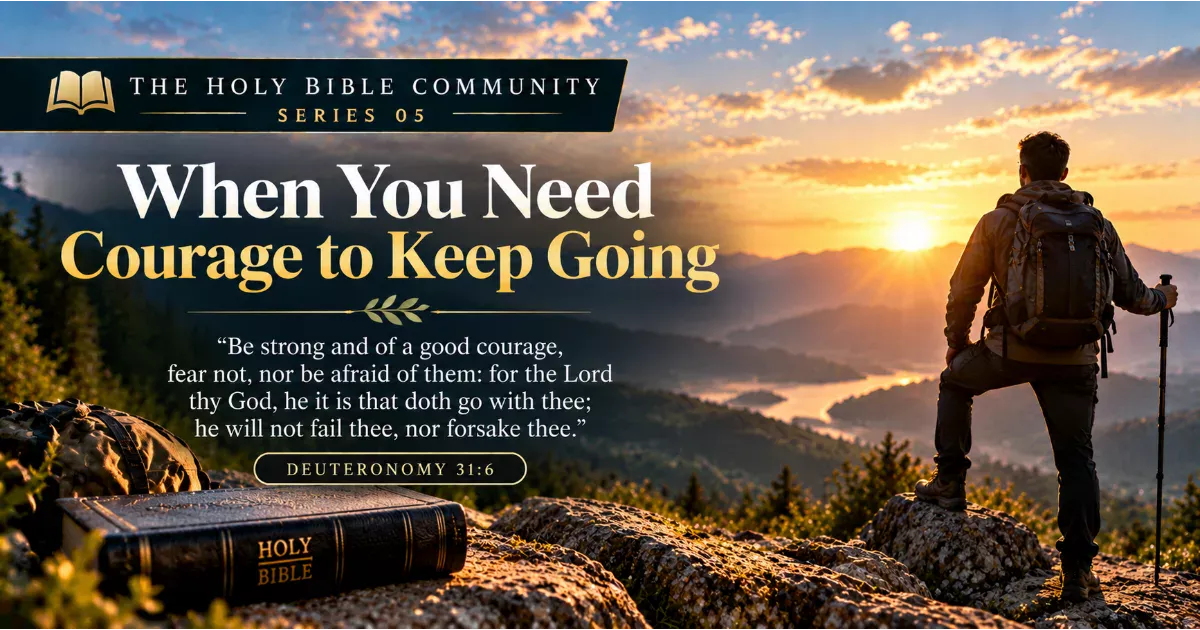
Be strong and of a good courage, fear not, nor be afraid of them: for the Lord thy God, he it is that doth go with thee; he will not fail thee, nor forsake thee.
Deuteronomy 31:6, King James Version
The Courage God Gives
There are moments in life when courage becomes necessary simply to keep moving forward. We may face situations that make us uncertain, afraid, discouraged, or overwhelmed. Sometimes the challenge is visible, such as a difficult responsibility, a major decision, financial pressure, opposition, or a painful change. At other times, the struggle happens within us through fear, doubt, insecurity, or the feeling that we are not strong enough for what lies ahead. Deuteronomy 31:6 speaks directly into these moments by reminding God's people that their courage does not have to come entirely from themselves. The foundation of their courage is the presence and faithfulness of God.
The verse says, “Be strong and of a good courage.” These words are not simply encouragement to become fearless people who never experience uncertainty. They are a call to remain faithful even when fear exists. Biblical courage is not the absence of fear. It is the decision to continue doing what is right while refusing to allow fear to become the final authority over our lives.
The Context Behind the Verse
The words of Deuteronomy 31:6 were spoken during an important transition in the history of Israel. Moses was approaching the end of his leadership, and Joshua was preparing to lead the people into the next stage of their journey. This was not a small responsibility. The people were facing an uncertain future and significant challenges ahead of them.
Joshua had to step into a role that had previously been occupied by Moses. From a human perspective, such a transition could naturally produce fear and insecurity. Moses had been the leader through extraordinary circumstances, and now Joshua had to continue the journey.
The message given to God's people was not that the future would be effortless. Instead, they were told to be strong and courageous because God would go with them.
That distinction is important. God did not promise that there would be no challenges. He promised His presence in the middle of those challenges.
Courage Begins With God's Presence
The strongest reason given for courage in this verse is found in the words, “for the Lord thy God, he it is that doth go with thee.” The foundation of courage is not personal ability. It is God's presence.
This principle can change the way we approach difficult situations. We often ask ourselves whether we are capable enough, experienced enough, prepared enough, or strong enough. These questions can be useful when preparing for a responsibility, but they can also become sources of fear if we believe everything depends entirely upon us.
Scripture redirects our attention toward God. The question is not only whether we are strong enough. The deeper question is whether we trust the God who is with us.
When God calls people to difficult responsibilities throughout Scripture, He repeatedly reminds them of His presence. Their confidence is not based solely on their abilities. It is based on the One who has called them.
Fear Does Not Have to Control You
The verse says, “fear not, nor be afraid of them.” Fear is a natural human response to uncertainty and danger. Experiencing fear does not automatically mean that a person lacks faith. The important question is what we do with that fear.
Fear can become destructive when it controls our decisions. It can convince us to avoid every risk, refuse every opportunity, remain silent when we should speak, or abandon responsibilities because we are afraid of failure.
God's instruction is not that we will never experience fear. His instruction is that fear should not become our master.
Courage means moving forward while trusting God even when fear is present.
A person can feel nervous and still act with courage. A person can feel uncertain and still make a wise decision. A person can feel weak and still remain faithful.
Courage Is Not Recklessness
Biblical courage should not be confused with recklessness. Being courageous does not mean ignoring danger, refusing wise advice, or making careless decisions. Scripture consistently values wisdom and discernment.
Courage means doing what is right despite legitimate difficulty or fear. Sometimes courage means moving forward. Sometimes courage means waiting. Sometimes courage means saying no. Sometimes courage means asking for help. Sometimes courage means admitting that a particular path is not right.
The presence of courage does not remove the need for wisdom. Instead, courage gives us the strength to follow wisdom even when doing so is difficult.
When You Are Entering a New Season
Transitions can create significant uncertainty. A new job, a new responsibility, a new relationship, a change in family circumstances, a new business venture, relocation, or another major life transition can make us wonder whether we are ready.
Joshua faced a major transition, and the people around him were entering a new chapter as well. The message was clear: the future did not have to be faced alone.
There may be moments when you look at your own future and wonder whether you are prepared. You may not have all the answers. You may not know exactly how things will unfold. But you can still take the next responsible step while trusting God.
God does not always show us the entire path before we begin walking. Sometimes He gives us enough direction for the next step and asks us to trust Him with what comes afterward.
When You Feel Unqualified
One of the most common reasons people avoid responsibility is the belief that they are not qualified. We may compare ourselves with people who seem more experienced, more confident, more talented, or more successful.
Comparison can make us overlook what God has already placed within us. It can cause us to focus so heavily on what we lack that we forget that God can work through imperfect people.
Joshua was not Moses. He did not need to become Moses. He needed to faithfully fulfill the responsibility God had given him.
This is an important lesson for us. We do not have to become someone else before we can be useful to God. We should grow, learn, and develop our abilities, but we should not believe that we need to possess someone else's personality, experience, or achievements before we can serve faithfully.
When Others Doubt You
There may be times when people around us do not believe in our abilities. Criticism can be painful, especially when it comes from people whose opinions matter to us.
Not every criticism is wrong. Sometimes other people see weaknesses that we need to address. Wisdom requires us to listen and learn rather than becoming defensive.
But there are also moments when people underestimate what God can do through us. In such moments, we should not allow someone else's doubt to become our identity.
Our value is not determined by the confidence other people have in us. Our ultimate identity comes from God.
Courage During Failure
Failure is one of the strongest forces behind fear. We may hesitate to try again because we remember what happened the first time. We may fear embarrassment, financial loss, rejection, or disappointment.
Yet failure does not have to become the end of our story. Scripture contains many examples of people who experienced mistakes and setbacks yet continued walking with God.
Courage sometimes means trying again after learning from what went wrong. It means accepting responsibility, making necessary changes, and refusing to allow one failure to define the rest of our lives.
God can use lessons learned through failure to develop humility, wisdom, patience, and perseverance.
Courage During Opposition
There may be situations where doing what is right places us in opposition to other people. Standing for truth, maintaining integrity, refusing dishonest practices, or living according to biblical principles may sometimes make us unpopular.
The natural response can be to remain silent or compromise simply to avoid conflict.
Deuteronomy 31:6 reminds us that our ultimate loyalty should not be determined by fear of people. If we know that something is right according to God's Word, we should have the courage to remain faithful while still treating others with respect and humility.
Courage does not require hostility. A person can stand firmly for their convictions while speaking with kindness.
Courage When You Are Tired
Not every difficult season is dramatic. Sometimes courage is required simply because we are exhausted. Long periods of responsibility, uncertainty, work, caregiving, financial pressure, or emotional strain can gradually reduce our strength.
When exhaustion continues for a long time, even ordinary responsibilities can feel overwhelming.
In such seasons, courage may mean slowing down, asking for help, seeking rest, and continuing one day at a time. We should not confuse exhaustion with spiritual failure. Human beings have physical and emotional limitations.
God's presence does not require us to pretend that we have unlimited energy. We can acknowledge our weakness and still trust Him.
God Will Not Fail You
The verse gives another powerful promise: “he will not fail thee, nor forsake thee.” These words provide a foundation for confidence.
Human beings can fail us. People can make promises and break them. Circumstances can change. Plans can collapse. People we trust may disappoint us. Even our own strength can fail.
God's faithfulness is different.
This does not mean that God will give us every outcome we desire. It means that His character remains faithful. His presence does not disappear simply because circumstances become difficult.
When we do not understand what God is doing, we can still remember who God is.
God Does Not Promise an Easy Road
It is important to notice what this verse does not say. It does not say that Israel would experience no opposition. It does not say that Joshua would never face difficult decisions. It does not say that everything would happen exactly as they imagined.
The promise was God's presence.
This is one of the most important truths in Scripture. God's presence is more valuable than a promise of a completely comfortable life. If our faith is based on the belief that God will remove every difficulty, our faith may collapse when difficulties arrive.
But if our faith is based on God's character and presence, we can continue trusting even when the road becomes difficult.
Courage to Make the Right Decision
There are moments when we know what the right thing is but hesitate because doing it will be uncomfortable. We may need to apologize, tell the truth, establish a boundary, reject an unethical opportunity, leave a harmful situation, or accept responsibility for a mistake.
Knowing what is right is not always enough. We also need courage to act upon it.
God can strengthen us to make difficult decisions with wisdom and integrity. Courage allows us to choose what is right even when the easier choice would be to avoid responsibility.
Courage to Wait
Courage is not always about action. Sometimes courage means waiting.
Waiting can be difficult because it feels passive, but there are seasons when rushing can create more problems than patience. We may want to force a situation because uncertainty makes us uncomfortable.
God's timing can require patience.
Waiting does not mean doing nothing. We can continue preparing, learning, praying, working, and making responsible decisions while waiting for circumstances to become clearer.
Courage sometimes means trusting God enough not to force what He has not opened.
Courage to Start Again
Life can sometimes take an unexpected turn. A plan can fail. A relationship can change. A career can end. A business can struggle. An opportunity can disappear.
Starting again requires courage because the memory of previous disappointment can create fear.
Yet a new beginning can also become an opportunity for growth. We can carry forward the lessons we learned without allowing the past to control the future.
God's faithfulness is not limited to our previous chapter. He can still guide us into what comes next.
Courage Through Prayer
Prayer is one of the ways we develop courage because prayer moves our attention away from our own limitations and toward God.
When we pray, we acknowledge that we need wisdom and strength. We can tell God what frightens us, ask for direction, and surrender the outcome.
Prayer does not always remove the challenge, but it can change the way we face it. Instead of believing that we must handle everything alone, we remember that God is with us.
A courageous life is not necessarily a life without fear. It is a life in which fear is repeatedly brought before God.
Courage Through Scripture
God's Word also strengthens courage by reminding us of who God is. When circumstances become overwhelming, our emotions can make us forget truths that we previously knew clearly.
Scripture brings our attention back to God's character. It reminds us that He is faithful, wise, merciful, just, loving, and powerful.
This is why regular engagement with Scripture matters. We do not only read the Bible when everything is going well. We build our understanding of God's character before difficult seasons arrive so that when challenges come, we have truth to return to.
A Message for Anyone Facing Fear Today
If you are facing something that makes you afraid, Deuteronomy 31:6 offers a powerful reminder. You do not have to pretend that the situation is easy. You do not have to convince yourself that you are stronger than you are. You do not have to know exactly how everything will work out.
You can acknowledge the fear and still choose faith.
You can recognize the difficulty and still take the next step.
You can admit that you need help and still be courageous.
Your courage does not have to come from believing that you are powerful enough to handle everything. It can come from believing that God is with you.
When the Future Looks Uncertain
Uncertainty can make even simple decisions feel overwhelming. We want to know whether the path ahead will succeed before we commit ourselves to it.
But life rarely provides complete certainty.
There will always be some unknowns. We cannot predict every conversation, opportunity, challenge, or change. If we wait for complete certainty before moving forward, we may remain stuck indefinitely.
Faith allows us to move forward responsibly without demanding complete knowledge of the future.
God may not show us everything, but He can show us enough for the next step.
The Courage to Keep Walking
There may be seasons when progress feels slow. You may be doing the right things without seeing immediate results. You may be praying without seeing immediate answers. You may be working faithfully while wondering whether your efforts matter.
During such seasons, courage can mean simply continuing.
Do not measure God's faithfulness only by the speed of visible results. Some things take time to develop. Character takes time. Relationships take time. Wisdom takes time. Healing takes time. Growth takes time.
Remaining faithful during a slow season is still progress.
The Promise of God's Faithfulness
The most powerful part of Deuteronomy 31:6 is not the command to be strong. It is the reason given for that command. God goes with His people, and He will not fail them or forsake them.
This changes the foundation of courage. We are not being asked to become independent people who never need help. We are being called to become people who trust God enough to move forward with Him.
Our strength may fluctuate, but God's faithfulness does not.
Our confidence may rise and fall, but God's character does not change.
Our circumstances may become uncertain, but God's presence remains.
A Final Reflection
Consider the area of your life where you currently need courage. Perhaps you are standing before a decision. Perhaps you are beginning something new. Perhaps you are facing opposition. Perhaps you are recovering from failure. Perhaps you are simply tired from carrying responsibilities for a long time.
Whatever the situation may be, remember the message given to God's people: “Be strong and of a good courage.” The command is followed by the reason that makes courage possible: “for the Lord thy God, he it is that doth go with thee.”
You do not have to face tomorrow alone. You do not have to possess unlimited strength. You do not have to know every detail of the future.
You can seek God, take the next faithful step, and trust Him with what comes afterward.
Courage is not pretending that there is nothing to fear. Courage is choosing to trust God even when something is difficult or frightening. It is choosing faith when fear tells you to stop. It is choosing obedience when compromise seems easier. It is choosing perseverance when giving up feels more comfortable.
May we become people who do not allow fear to determine the direction of our lives. May we seek God's wisdom before making decisions, remain humble when we succeed, learn when we fail, and continue walking when the road becomes difficult.
Whatever lies ahead, remember the promise contained in this verse. The Lord goes with His people. He does not abandon them when the journey becomes difficult. His presence gives us reason to continue, His faithfulness gives us reason to hope, and His strength gives us courage to face what comes next.
When you feel afraid, remember who walks with you.
When you feel weak, remember who strengthens you.
When you feel uncertain, remember who knows the future.
When you feel alone, remember that God has not forsaken you.
The road ahead may not always be easy, but you do not have to walk it without God.
#TheHolyBible #BibleCommunity #BibleVerse #Deuteronomy316 #Deuteronomy31 #BeStrong #BeCourageous #CourageInGod #FaithInGod #TrustGod #GodsWord #BibleStudy #BibleReflection #ChristianFaith #ChristianLiving #ChristianCommunity #DailyBible #Scripture #Prayer #HopeInGod #JesusChrist #GodIsFaithful #WalkByFaith #ChristianLife