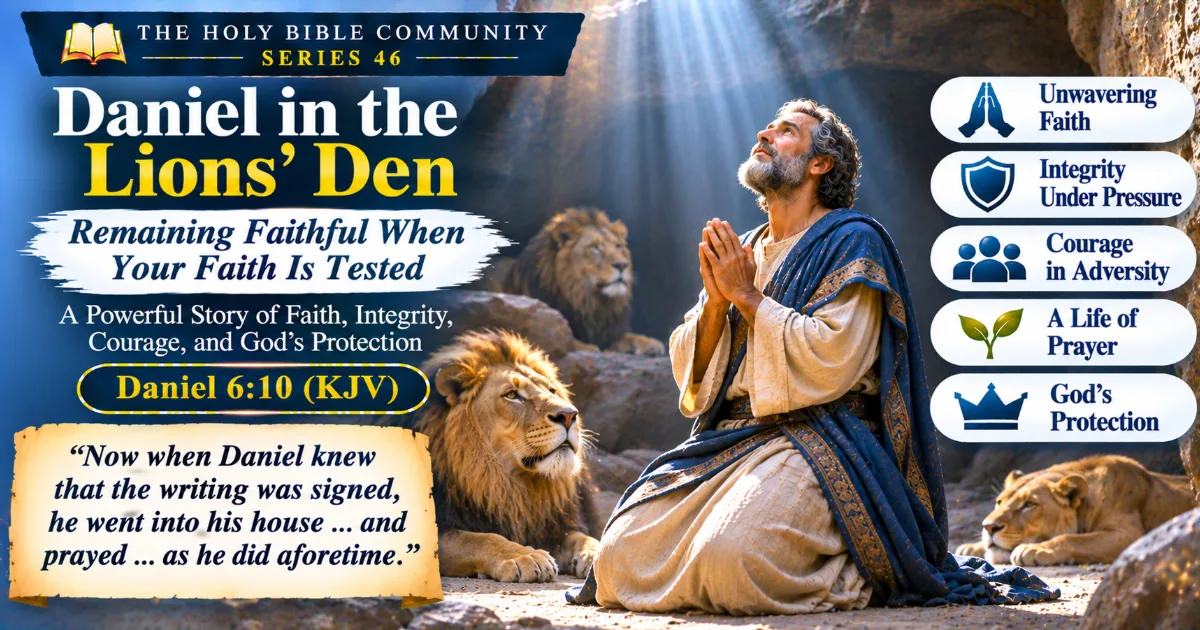
Key Bible Verse: Daniel 6:10 (KJV)
"Now when Daniel knew that the writing was signed, he went into his house; and his windows being open in his chamber toward Jerusalem, he kneeled upon his knees three times a day, and prayed, and gave thanks before his God, as he did aforetime."
Faithfulness When Obedience Becomes Difficult
Faith is easy to profess when life is peaceful, circumstances are favourable, and nobody challenges our beliefs. It becomes much harder when remaining faithful brings criticism, rejection, professional consequences, or personal danger. Many people discover the true condition of their faith not during comfortable seasons but when they must choose between following their convictions and protecting their immediate interests.
The story of Daniel in the lions' den is one of the most powerful accounts of faithfulness under pressure in the Bible. Recorded in Daniel chapter 6, it describes a man who continued serving God even when a royal decree made his daily prayer life punishable by death. Daniel understood the danger, knew the consequences, and had every reason to hide his devotion. Nevertheless, he continued praying as he had always done.
Continue Reading
Daniel's courage was not the result of a sudden emotional reaction. It came from a lifetime of consistent faithfulness. His relationship with God was not something he remembered only during emergencies. Prayer was already an essential part of his daily life. When the crisis arrived, he did not need to invent a new kind of faith. He continued practising the faith that had shaped his character for years.
This story teaches us that genuine faith is not simply about believing in God when everything goes well. It is also about remaining committed to Him when obedience becomes costly. It reminds us that human authority has limits, that integrity matters even when others are watching, and that God remains sovereign even in circumstances that appear impossible.
Daniel's Life in a Foreign Kingdom
Daniel's story began long before the lions' den. He was among the people of Judah taken into captivity when Babylon conquered Jerusalem. He was separated from his homeland, his familiar surroundings, and the religious and cultural environment in which he had grown up.
The Babylonian authorities selected young people from prominent families and brought them into the royal court. They were expected to learn the language, literature, and customs of Babylon so that they could eventually serve the empire. Daniel was among those chosen.
Although Daniel lived in a foreign kingdom, he did not allow his surroundings to determine his identity. He faced pressure to adapt to a culture that did not share his devotion to God, yet he remained committed to his convictions. Daniel chapter 1 describes how he resolved not to defile himself with the king's food and drink.
His decision was significant because he was living under the authority of a powerful ruler. Refusing the royal provision could have placed his position and even his life at risk. However, Daniel approached the situation with wisdom and respect. He requested permission to follow a different arrangement and demonstrated that faithfulness did not require unnecessary hostility.
God gave Daniel knowledge, understanding, and wisdom. Over time, he became known for his ability to interpret dreams and understand difficult matters. He served under different rulers and experienced significant changes in political leadership.
His life demonstrates that a person can remain faithful to God while working in an environment that does not share the same beliefs. Daniel did not need to abandon his convictions to become useful in public service. His character, discipline, and wisdom allowed him to serve effectively without surrendering his devotion.
Daniel's Integrity Made Him Stand Out
Daniel 6 introduces a new political situation. Darius the king appointed officials and administrators to govern the kingdom. Daniel was one of three presidents placed over the leaders of the provinces.
The king considered appointing Daniel over the entire kingdom because an excellent spirit was found in him. Daniel's competence and integrity distinguished him from the other officials.
This detail is important because the conflict that followed was not caused by Daniel's incompetence, dishonesty, or misuse of authority. His opponents could not find a legitimate reason to accuse him concerning his responsibilities.
Daniel 6:4 explains that the presidents and princes sought to find an occasion against Daniel concerning the kingdom, but they could find none. He was faithful, and neither error nor fault could be found in him.
Imagine working in an environment where people are actively searching for evidence of wrongdoing. They examine your decisions, question your responsibilities, and look for mistakes that might damage your reputation. Daniel experienced this kind of hostility, yet his professional conduct remained above reproach.
His integrity was not limited to religious activities. It influenced the way he handled public responsibilities. He was dependable, disciplined, and trustworthy.
This teaches an important lesson about Christian character. Faithfulness to God should influence every part of life, including professional responsibilities, financial decisions, relationships, leadership, and personal conduct. A person cannot separate devotion to God from the way they treat other people.
Integrity is particularly important when nobody appears to be rewarding it. Daniel did not become honest because the king was watching. His faithfulness was part of who he was.
Jealousy Turned Against Daniel
Daniel's success created resentment among the other officials. Instead of recognising his ability and learning from his example, they searched for a way to remove him.
Their investigation revealed that they could not successfully accuse him through his official responsibilities. They therefore decided to attack the one area where they knew he would not compromise: his relationship with God.
Daniel 6:5 records their conclusion that they would find no occasion against him except concerning the law of his God.
This was a deliberate attempt to turn Daniel's faith into a weapon against him. His opponents understood that he would not abandon his devotion merely to protect his position.
Jealousy can lead people to behave in destructive ways. Rather than improving their own character, they may attempt to damage someone whose integrity exposes their shortcomings. The officials did not seek justice. They wanted Daniel removed.
The story also reminds us that doing what is right does not guarantee that everyone will appreciate us. A person may be honest and still experience false accusations. Someone may work diligently and still face resentment. A person may act with kindness and still encounter hostility.
However, Daniel's example shows why our values should not depend entirely on the reactions of other people. If we change our principles every time someone disapproves, our character will become controlled by external pressure.
The Decree That Challenged Daniel's Faith
The officials approached King Darius with a proposal designed to trap Daniel. They suggested that for thirty days nobody should make a request to any god or man except the king. Anyone who disobeyed would be thrown into a den of lions.
They presented the proposal as though it demonstrated loyalty and unity throughout the kingdom. The king accepted their recommendation and signed the decree.
According to the law of the Medes and Persians, the decree could not be altered once it had been established. This meant that Daniel's opponents had created a legal situation that would be difficult to reverse.
Their plan depended on one assumption: Daniel would continue praying to God.
Daniel now faced a serious decision. He could temporarily stop praying publicly and avoid attracting attention. He could hide his devotion until the thirty days had passed. He could attempt to find a private arrangement that would protect his position.
But the question was not simply whether Daniel could avoid punishment. The deeper question was whether he would allow a human decree to replace his commitment to God.
The situation reveals the difference between convenience and conviction. Convenience asks what will make life easier. Conviction asks what is right, even when the right choice is difficult.
Daniel understood the consequences, but he did not allow fear to determine his relationship with God.
Daniel Continued Praying as Before
Daniel 6:10 provides the central moment of the story. When Daniel learned that the decree had been signed, he went into his house, opened his windows toward Jerusalem, knelt three times a day, prayed, and gave thanks before God as he had done previously.
The phrase "as he did aforetime" is especially meaningful. Daniel did not begin praying because he wanted to make a public statement against the king. He did not create a dramatic religious performance to attract attention. He continued a regular spiritual practice that already shaped his life.
His prayer routine was established before the crisis. The decree changed the political circumstances, but it did not change Daniel's devotion.
This offers a powerful lesson about spiritual discipline. The habits we develop during peaceful seasons can strengthen us when difficult seasons arrive. A person who regularly seeks God, studies Scripture, practises gratitude, and develops a life of prayer is building a foundation that can support them during uncertainty.
Prayer should not be treated only as an emergency response. It is a continuing relationship with God. Daniel did not approach God only when he needed rescue. He prayed consistently because his relationship with God mattered to him.
His example also teaches us that gratitude can remain part of prayer during difficult circumstances. Daniel did not merely ask God to protect him. Scripture specifically says that he gave thanks.
Gratitude does not mean pretending that danger is harmless or that suffering does not exist. It means recognising God's goodness even when circumstances are painful or uncertain.
Courage Is Not the Absence of Fear
Daniel's decision required courage. He knew the decree had been created specifically to trap him. He understood that the punishment was serious, yet he continued doing what he believed was right.
Courage is often misunderstood as the absence of fear. In reality, courage can involve recognising danger and choosing faithfulness despite it.
Daniel was not careless about the consequences. His decision was deliberate. He understood the seriousness of the situation but refused to make fear the highest authority in his life.
This distinction matters in our own lives. Faith does not require people to ignore danger, reject wisdom, or place themselves unnecessarily in harmful situations. It calls believers to remain committed to what is right while exercising discernment.
There may be moments when honesty is uncomfortable, when defending someone requires effort, or when refusing an unethical request affects a professional opportunity. In such circumstances, courage means acting with integrity rather than allowing fear to control every decision.
Daniel's courage came from confidence in God, not confidence in his own ability to control the outcome.
Daniel's Enemies Reported Him to the King
The officials knew that Daniel continued praying. They approached the king and reminded him of the decree. They then reported that Daniel, one of the captives from Judah, had disregarded the royal command.
Their accusation was carefully presented to make Daniel appear disloyal. They emphasised his continued worship of God and his refusal to obey the decree.
King Darius immediately understood the seriousness of the situation. Daniel was a trusted official, and the king recognised that the decree had been used against him.
Daniel 6:14 says that the king was displeased with himself and set his heart on Daniel to deliver him. He laboured until the going down of the sun to find a way to rescue him.
This moment shows that even powerful rulers can become trapped by their own decisions. Darius had authority over the kingdom, but the legal system he had accepted prevented him from easily correcting the injustice.
The officials continued pressing the matter. They reminded the king that the law could not be changed. Eventually, Darius was forced to order Daniel's punishment.
The king's response reveals the personal cost of making decisions without sufficient wisdom. Leaders must think carefully before approving policies, agreements, or actions that affect other people. Authority should be exercised with responsibility rather than through impulsive decisions.
The Lions' Den: When the Situation Appears Hopeless
Daniel was brought to the lions' den and thrown inside. The king spoke words that reveal his hope that Daniel's God would deliver him.
Daniel 6:16 records the king saying, "Thy God whom thou servest continually, he will deliver thee."
A stone was placed over the mouth of the den, and the king sealed it with his own signet and the signet of his lords. The arrangement made it clear that Daniel had been placed under the sentence of the law.
From a human perspective, the situation appeared hopeless. Daniel was inside a den of lions, unable to escape through ordinary means. The officials had achieved what they wanted, and the king could do little more.
Yet the story reminds readers that human limitations do not define the limits of God's power.
There are seasons when people face circumstances they cannot resolve through their own strength. They may encounter serious illness, financial difficulties, injustice, broken relationships, professional setbacks, or situations in which no immediate solution is visible.
The account of Daniel does not promise that every difficult situation will end in the same way. The Bible contains many faithful people who experienced suffering and death despite their devotion. However, Daniel's deliverance demonstrates that God is not powerless in circumstances that appear impossible.
Faith trusts God's sovereignty without demanding that He always follow the outcome we prefer.
A Night of Uncertainty for the King
The king returned to his palace, but he could not find peace. Daniel 6:18 describes how Darius spent the night fasting. Instruments of music were not brought before him, and his sleep went from him.
The contrast between the king and Daniel is striking. The king lived in a palace, surrounded by comfort and authority, yet he could not rest. Daniel was in a lions' den, facing mortal danger, but his faith was not dependent on the security of royal surroundings.
The story does not tell us everything Daniel experienced during that night. It focuses instead on what God did to protect him.
At daybreak, Darius hurried to the den and called out to Daniel with a sorrowful voice. He asked whether the living God had been able to deliver him from the lions.
The king's question reveals both uncertainty and hope. He knew Daniel's devotion, but he did not know what had happened during the night.
Sometimes people who observe our faith may not fully understand it until they see how we respond to difficult circumstances. Daniel's consistent devotion had already made an impression on the king. His survival would make that testimony even more powerful.
God Shut the Lions' Mouths
Daniel answered the king. Daniel 6:22 records his words:
"My God hath sent his angel, and hath shut the lions' mouths, that they have not hurt me: forasmuch as before him innocency was found in me; and also before thee, O king, have I done no hurt."
Daniel was alive. God had protected him from the lions.
The king was exceedingly glad and commanded that Daniel be lifted out of the den. When Daniel was examined, no manner of hurt was found upon him because he believed in his God.
This is the central miracle of the chapter. Daniel's survival was not the result of his political influence, personal strength, or ability to negotiate with the lions. The passage presents his deliverance as an act of divine intervention.
The account also emphasises that Daniel had done no wrong. He had not been punished for corruption or violence. He suffered because he remained faithful to God.
This is an important distinction. The story should not be used to suggest that every person who suffers is being punished for wrongdoing. Scripture itself contains many examples of righteous people experiencing hardship.
Daniel's experience reminds us that suffering is not always evidence of personal failure. Sometimes doing what is right brings opposition. Sometimes people face injustice despite their integrity.
God's presence is not measured only by the absence of difficulty. Daniel's faith was present in the lions' den, and God's power was revealed there.
The Consequences for Those Who Planned the Injustice
After Daniel was lifted out of the den, the king commanded that the men who had maliciously accused him be brought and cast into the lions' den, along with their families.
The passage records that the lions overpowered them before they reached the bottom of the den.
This part of the narrative is severe, and it should be read within its historical and biblical context rather than treated as permission for personal revenge. Daniel did not organise a retaliation against his enemies. He remained faithful to God and allowed the king to administer the law.
The episode demonstrates the seriousness of the officials' deception and the consequences of their malicious scheme.
It also reminds us that the pursuit of power through dishonesty can produce devastating results. The officials had manipulated the king, misused authority, and attempted to destroy an innocent man. Their actions exposed the destructive nature of jealousy and political manipulation.
For modern readers, the practical lesson is not to seek revenge against those who mistreat us. It is to avoid becoming the kind of person who uses deception, false accusations, or authority to harm others.
The King Recognised the Living God
After Daniel's deliverance, King Darius issued a decree throughout his kingdom. He instructed people to fear and reverence the God of Daniel.
Daniel 6:26 describes God as the living God, steadfast for ever, whose kingdom shall not be destroyed and whose dominion shall be even unto the end.
The king also acknowledged God's ability to deliver and rescue, and to work signs and wonders in heaven and earth.
The events had changed the king's understanding of Daniel's God. The official who had been condemned by an unjust decree became the central witness to God's power.
Daniel's faithfulness influenced the environment around him. His devotion was not hidden by his position or weakened by political pressure. It became visible through his consistent character and his response to danger.
This is an important lesson for believers today. Our faith can influence families, workplaces, educational institutions, and communities through the way we live. People may disagree with our beliefs, but they should be able to recognise honesty, humility, compassion, and responsibility in our conduct.
A Christian testimony is not built only through religious words. It is also revealed through decisions, attitudes, and behaviour.
Faithfulness in the Workplace
Daniel's story has a meaningful connection with modern professional life. He served in a government administration where political competition, jealousy, and pressure were part of his environment.
He did not abandon his responsibilities because he worked under a foreign ruler. He performed his duties with excellence while maintaining his spiritual commitments.
Modern professionals may face situations in which their values are challenged. They may be asked to manipulate information, mislead customers, conceal mistakes, participate in unfair practices, or compromise their principles for financial gain.
Daniel's example encourages believers to maintain integrity even when doing so is inconvenient.
A person should not use faith as an excuse for irresponsibility. Daniel was respected because he was both spiritually committed and professionally dependable. His faith influenced his work rather than replacing the need to perform it well.
Employees, business owners, managers, and leaders can apply this principle by treating people fairly, keeping promises, handling resources responsibly, and refusing dishonest practices.
Success achieved through dishonesty cannot provide the same peace as work performed with integrity.
Building a Consistent Life of Prayer
One of the most practical lessons from Daniel's experience is the importance of regular prayer.
Daniel prayed three times a day. The significance of this detail is not that every believer must follow exactly the same schedule. Rather, it demonstrates that Daniel had established a consistent pattern of seeking God.
Many people pray mainly when they experience a crisis. They remember prayer when facing illness, uncertainty, disappointment, or a difficult decision. While God welcomes us to approach Him in every circumstance, prayer is meant to be part of an ongoing relationship.
A regular prayer life helps believers develop spiritual discipline. It creates opportunities to express gratitude, confess mistakes, seek wisdom, pray for others, and reflect on God's Word.
Consistency does not require complicated routines. A person can begin with a sincere period of prayer each morning, spend time reflecting on Scripture, and turn to God throughout the day.
The purpose is not to impress others or measure spirituality through the number of minutes spent praying. The purpose is to develop a genuine relationship with God.
Daniel's example shows that spiritual habits formed during ordinary days can become a source of strength during extraordinary challenges.
What Daniel Teaches Us About Fear
Fear is a natural human response to danger and uncertainty. The problem arises when fear becomes the deciding authority in our lives.
Daniel's opponents expected the threat of death to make him abandon his devotion. They believed that the possibility of punishment would be enough to change his behaviour.
Daniel's response demonstrates that his relationship with God was more important than temporary security.
In modern life, fear may take different forms. People may fear losing employment, disappointing family members, being rejected by friends, facing criticism, or missing opportunities. These fears can influence decisions even when no physical danger is involved.
Daniel encourages us to examine whether fear is causing us to compromise our values.
This does not mean that every disagreement requires confrontation or that believers should deliberately create conflict. Wisdom, patience, and peaceful communication are important. However, when a clear moral responsibility is involved, fear should not become an excuse for abandoning what is right.
Faith gives believers the strength to act with courage while trusting God with what they cannot control.
Trusting God Without Demanding a Particular Outcome
The story of Daniel in the lions' den ends with extraordinary deliverance. It is natural to focus on the miracle, but an equally important lesson is the faith Daniel demonstrated before knowing the outcome.
He continued praying even though he could not guarantee that God would save him from the lions.
This is the difference between genuine trust and a demand for a particular result. Genuine faith does not treat God as someone who must always provide the outcome we request. It trusts His wisdom, character, and authority even when the future remains uncertain.
The Bible contains other examples of faithful people who faced danger without receiving the same kind of immediate physical deliverance. Hebrews 11 describes people who experienced victories through faith, while others endured suffering and persecution.
Their experiences remind us that faithfulness is not a guarantee of an easy life. It is a commitment to God that remains meaningful regardless of circumstances.
When we pray for healing, protection, provision, or justice, we can ask boldly while remaining humble before God's will. We can take responsible action and seek appropriate help while continuing to trust Him.
Daniel's story encourages us to measure faithfulness not only by what happens to us but also by how we respond to the circumstances we face.
Practical Ways to Apply Daniel's Example
Daniel's life offers several practical lessons for everyday Christian living.
First, develop spiritual habits before a crisis arrives. Do not wait until life becomes difficult to begin praying, studying Scripture, or seeking God's guidance. Build a consistent relationship with Him through ordinary daily practices.
Second, maintain integrity in every responsibility. Be honest in professional work, financial decisions, personal relationships, and private conduct. Integrity should not change according to who is watching.
Third, refuse to let jealousy control your behaviour. When another person succeeds, learn from their example rather than attempting to damage their reputation. Celebrate honest achievement and concentrate on improving your own character.
Fourth, respond to pressure with wisdom. Daniel's story does not encourage unnecessary conflict. He remained respectful while refusing to abandon his faith. Believers should seek peaceful and responsible ways to handle disagreements without surrendering important convictions.
Fifth, remember that God is present in difficult circumstances. A painful season does not mean that God has abandoned you. Continue seeking Him, asking for wisdom, and taking responsible steps forward.
Finally, allow your conduct to become a testimony. Daniel's faith influenced a king and an entire kingdom. Your daily choices may also influence people who observe your honesty, patience, compassion, and courage.
Conclusion: Remain Faithful in Every Season
Daniel's experience in the lions' den teaches us that faithfulness is not measured only by what we say when life is comfortable. It is revealed through the decisions we make when our convictions are challenged.
Daniel was far from his homeland, served under foreign rulers, and faced jealous officials who wanted to destroy him. Yet he remained faithful. His prayer life continued, his integrity remained intact, and his trust in God did not disappear when the consequences became serious.
The lions' den appeared to be the end of his story, but God demonstrated that the power of earthly rulers and the danger of human circumstances were not greater than His authority.
We may never face a literal lions' den, but we will encounter situations that test our faith. We may have to choose between honesty and convenience, conviction and popularity, or obedience and personal advantage. In those moments, Daniel's example reminds us to remain steadfast.
Let us develop a faith that is consistent in ordinary life, courageous under pressure, humble in success, and trusting during uncertainty. Let us remember that our responsibility is to remain faithful to God, even when we cannot see how circumstances will unfold.
The most important lesson of Daniel's story is not simply that God can close the mouths of lions. It is that a faithful relationship with God is worth protecting, even when the world attempts to make us abandon it.
A Prayer for Courage and Faithfulness
Heavenly Father, thank You for the example of Daniel and his unwavering devotion to You. Help me develop a sincere and consistent relationship with You, not only during difficult moments but throughout every day of my life.
Give me the courage to stand for what is right when I face pressure, criticism, or opposition. Protect my heart from jealousy, dishonesty, pride, and fear. Teach me to act with wisdom, humility, and integrity in my family, workplace, and relationships.
When I face circumstances that seem impossible, remind me that You remain sovereign and that Your presence does not depend on my surroundings. Help me trust Your wisdom even when I do not understand the outcome.
Strengthen my prayer life, deepen my understanding of Your Word, and make my actions a reflection of Your goodness. May my faith remain steady in seasons of comfort and seasons of difficulty.
In Jesus Christ's name, I pray. Amen.
#TheHolyBible #BookOfDaniel #FaithfulnessToGod #CourageInFaith #TrustInGod