
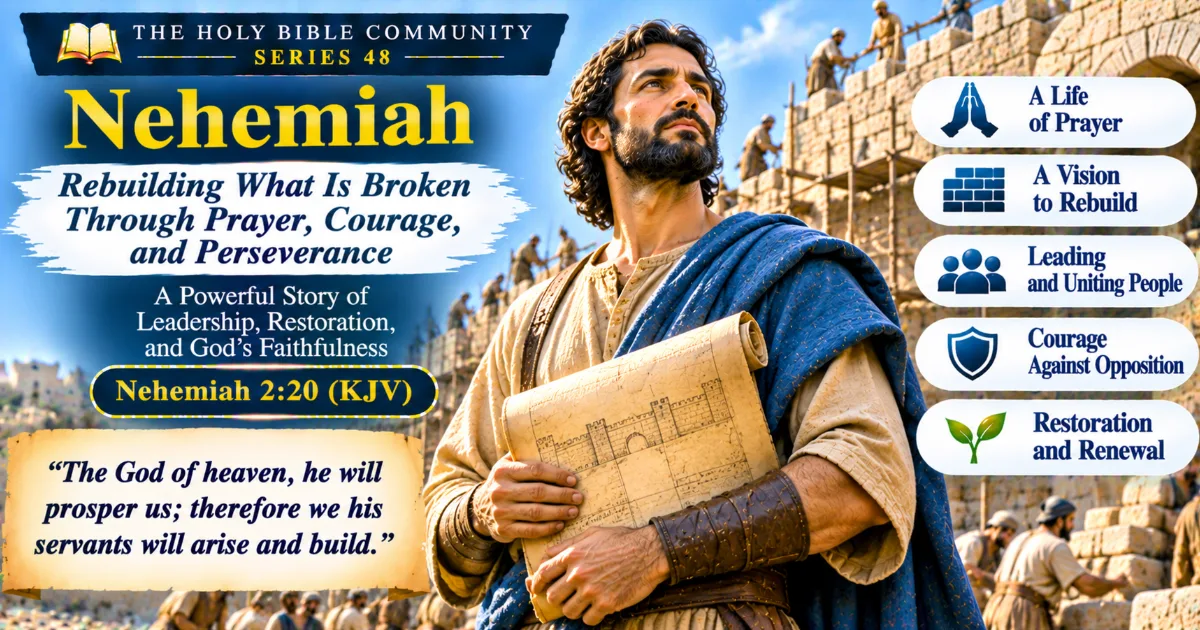
Key Bible Verse: Nehemiah 2:20 (KJV)
"Then answered I them, and said unto them, The God of heaven, he will prosper us; therefore we his servants will arise and build: but ye have no portion, nor right, nor memorial, in Jerusalem."
When God Calls You to Rebuild
There are seasons in life when we look around and recognise that something important has been broken. A relationship may have been damaged, a family may be struggling, a career may have taken an unexpected turn, or a community may be facing serious challenges. Sometimes the damage is visible, while at other times it exists quietly beneath the surface. Whatever the situation, rebuilding requires more than wishing things were different. It requires faith, courage, wisdom, discipline, and a willingness to take action.
The story of Nehemiah is one of the Bible's most powerful accounts of rebuilding. It describes a man who heard about the ruined condition of Jerusalem, allowed the news to affect his heart, sought God's guidance, and eventually accepted the responsibility of leading a major restoration project. His journey demonstrates how prayer and practical leadership can work together to accomplish meaningful change.
Continue Reading
Nehemiah was not introduced as a king or a military commander. He served as a cupbearer to King Artaxerxes of Persia. Yet when he learned that Jerusalem's walls remained broken and its gates had been burned, he recognised that the situation required attention. He did not dismiss the problem as someone else's responsibility. He prayed, planned, requested permission, travelled to Jerusalem, organised the people, and faced opposition without abandoning the work.
The restoration of Jerusalem's walls was not merely a construction project. The walls represented protection, dignity, stability, and the restoration of a city central to the identity of the Jewish people. Their ruined condition reflected the consequences of past destruction and the difficult circumstances faced by those who had returned from exile.
Nehemiah's story teaches us that meaningful rebuilding begins when we stop ignoring what is broken, seek God's wisdom, and become willing to participate in the work. It also reminds us that opposition does not necessarily mean we are pursuing the wrong purpose. Sometimes the most valuable work requires perseverance precisely because it matters.
Jerusalem's Broken Condition
To understand Nehemiah's mission, it is important to understand the condition of Jerusalem during his time.
Jerusalem had experienced destruction when the Babylonian forces conquered Judah. The city was devastated, the temple was destroyed, and many inhabitants were taken into exile. The destruction affected not only buildings but also the political, social, and religious life of the people.
After the Persian Empire came to power, some Jewish exiles were permitted to return to their homeland. Under earlier Persian rulers, the temple had been rebuilt, providing an important centre for worship. However, the city's walls and gates remained in a damaged condition.
This created serious difficulties for the people living there. A city without adequate walls was vulnerable to attack and intimidation. Its inhabitants could struggle to establish a stable and secure community.
The condition of Jerusalem therefore represented a much larger problem than unfinished construction. It reflected vulnerability, humiliation, and the unfinished restoration of a people who had already experienced years of displacement.
Nehemiah lived in the Persian capital, far from Jerusalem. He was not personally experiencing every difficulty faced by the people there, but he remained deeply concerned about their condition.
His response reminds us that distance should not prevent compassion. We may not personally experience every problem affecting our families, communities, or societies, but we can still care enough to understand the situation and consider what responsible help is possible.
Nehemiah Hears About the Ruins
Nehemiah chapter 1 begins with a conversation that changed the direction of Nehemiah's life.
Hanani, one of Nehemiah's brethren, arrived with certain men from Judah. Nehemiah asked about the Jewish people who had escaped captivity and about Jerusalem.
The report was deeply troubling. Nehemiah 1:3 describes the condition of the people as being in great affliction and reproach. The wall of Jerusalem was broken down, and its gates had been burned with fire.
Nehemiah could have treated the report as unfortunate news from a distant place. He could have returned to his daily responsibilities without allowing the situation to affect him.
Instead, he was deeply moved.
Nehemiah 1:4 tells us that when he heard these words, he sat down, wept, mourned for certain days, fasted, and prayed before the God of heaven.
His response reveals an important principle of leadership: meaningful action often begins with genuine concern.
A person who does not care about a problem is unlikely to accept the responsibility of addressing it. Nehemiah's concern was not superficial. He allowed the suffering of others to affect his heart.
This teaches us that compassion should move beyond words. When we become aware of a serious problem, we should consider whether there is something responsible we can do to help.
Prayer Before Action
Nehemiah's first response was prayer.
Before approaching the king, organising workers, or preparing a construction plan, he turned to God.
His prayer in Nehemiah 1:5-11 is a thoughtful expression of worship, confession, remembrance, and petition. He began by recognising God's greatness, faithfulness, and mercy.
He then confessed the sins of the people of Israel, acknowledging that they had not kept God's commandments. Nehemiah did not approach the situation with an attitude of superiority. Although he was concerned about the failures of the nation, he included himself and his family in the confession.
He also reminded God of His promises concerning the restoration of His people.
Finally, he asked God to grant him mercy before the king.
This prayer reveals several important lessons.
First, Nehemiah recognised that God was greater than the problem. Jerusalem's condition was serious, but it did not place the situation beyond God's authority.
Second, he approached God with humility. He acknowledged the failures of the people rather than pretending that everything had been right.
Third, he remembered God's promises. His prayer was rooted in the character and faithfulness of God.
Fourth, he asked for help with a specific responsibility. Nehemiah was preparing to approach the king, and he understood that he needed favour and wisdom.
Prayer was not a substitute for action. It prepared him for action.
This distinction is important in Christian life. Prayer should not become an excuse for avoiding responsibilities. It should guide our decisions, strengthen our hearts, and help us act with wisdom.
Nehemiah's Position in the King's Palace
Nehemiah served as the king's cupbearer. This was an important position within the royal household.
The cupbearer was responsible for handling the king's drink and serving in close proximity to him. The position required trust because the cupbearer had access to the ruler and could be involved in matters of royal security and personal service.
Nehemiah's position gave him an opportunity to approach the king, but it also meant that he had to behave carefully.
He was not a free individual who could simply leave the palace and travel wherever he wished. His responsibilities were connected to the royal administration.
This created a practical challenge. Nehemiah felt called to help Jerusalem, but he needed permission, resources, and the ability to travel.
His situation demonstrates that people can serve God faithfully within ordinary professional responsibilities. Nehemiah did not begin his mission by abandoning his existing position. He recognised that his circumstances might provide an opportunity to contribute to a greater purpose.
Sometimes the opportunities we need are connected to responsibilities we already have. Our work, relationships, skills, and experience may become instruments through which we can help others.
Nehemiah Approaches King Artaxerxes
In Nehemiah chapter 2, the king noticed that Nehemiah appeared sad. The king asked why his countenance was sad when he was not sick.
Nehemiah explains that he was afraid. This detail is important because it shows that courage does not mean never feeling fear.
He was standing before a powerful ruler, and the subject he wanted to discuss concerned the condition of Jerusalem. The king's response could affect his position and his future.
Nehemiah briefly prayed to the God of heaven before answering.
He explained that the city where his ancestors were buried lay in ruins and its gates had been destroyed by fire. The king asked what he wanted.
Nehemiah requested permission to travel to Judah and rebuild the city. He also requested letters that would provide safe passage through the territories he needed to cross and access to timber for the construction work.
The king granted his requests.
This moment reveals how prayer, courage, preparation, and practical communication can work together.
Nehemiah did not approach the king with vague complaints. He understood the problem and could explain what he needed.
He also recognised that the project required more than personal enthusiasm. It needed official permission, travel arrangements, and building materials.
His example teaches us to prepare carefully when presenting an important request. Whether we are seeking support for a community project, proposing a business initiative, or addressing a family responsibility, clarity and preparation matter.
Nehemiah Reaches Jerusalem
After receiving the king's permission and letters, Nehemiah travelled to Jerusalem.
He arrived and spent three days there before beginning his inspection of the city.
Nehemiah 2:13 describes how he went out by night through the valley gate toward the dragon well and the dung port. He examined the broken walls and the gates that had been destroyed by fire.
The account describes the practical difficulties of the damaged city. In certain places, the destruction was so severe that there was not enough room for the animal Nehemiah was riding to pass.
This inspection was an important part of the rebuilding process.
Nehemiah did not immediately announce a plan without understanding the actual condition of the walls. He examined the damage, assessed the situation, and considered what would be required.
This teaches an important lesson about responsible leadership. Before attempting to solve a problem, we should understand it.
People sometimes rush into solutions because they are excited about making changes. However, effective rebuilding requires accurate information, careful observation, and an understanding of the resources available.
Nehemiah's example reminds us that faith and practical assessment are not opposites. We can trust God while also examining the situation honestly.
A Vision Shared With the People
After completing his inspection, Nehemiah addressed the rulers, priests, nobles, and other people involved in the work.
He explained the distressing condition of Jerusalem and described how the city lay in ruins. He also told them about God's good hand upon him and the favourable response of the king.
Nehemiah 2:17 records his appeal:
"Come, and let us build up the wall of Jerusalem, that we be no more a reproach."
His message was direct and practical. He did not simply tell people that the city was in a bad condition. He invited them to participate in the solution.
Nehemiah shared the vision, explained the opportunity, and reminded the people that God had helped him obtain the necessary support.
The people responded positively. They said, "Let us rise up and build."
This moment demonstrates the importance of shared responsibility.
Nehemiah could not rebuild the entire city wall alone. The work required many people, each contributing according to their abilities and responsibilities.
A good leader does not attempt to become the only person capable of doing everything. Instead, a good leader helps others understand the purpose and encourages them to participate.
Families, businesses, organisations, and communities also depend on cooperation. Meaningful progress becomes possible when people recognise a shared responsibility and work toward a common goal.
Opposition Begins Before the Work Is Complete
Nehemiah's mission immediately attracted opposition.
Sanballat the Horonite, Tobiah the servant, and Geshem the Arabian heard about the rebuilding effort. They were displeased that someone had come to seek the welfare of the children of Israel.
They mocked and questioned the people. They suggested that the rebuilding effort was a form of rebellion against the king.
Nehemiah responded by declaring that the God of heaven would prosper the work and that the people would arise and build.
He also made it clear that those opposing the work had no legitimate claim or authority over Jerusalem's restoration.
His response demonstrates confidence without surrendering the mission.
The opposition did not prove that the project was wrong. The work was important, and the people needed to remain focused.
In life, worthwhile efforts can attract criticism. People who attempt to improve a situation may encounter discouragement from those who prefer the existing conditions or feel threatened by change.
However, not every criticism should be ignored. Responsible leaders must distinguish between useful feedback and deliberate attempts to discourage or obstruct legitimate work.
Nehemiah understood the difference between examining a concern and allowing mockery to control the mission.
Every Person Had a Part in Rebuilding
Nehemiah chapter 3 provides a detailed account of the people who participated in rebuilding Jerusalem's walls.
The chapter mentions priests, rulers, craftsmen, merchants, families, and other individuals. Different groups repaired different sections of the wall and its gates.
The record is significant because it shows that the rebuilding effort was not the achievement of one individual.
People contributed according to their abilities and circumstances. Some repaired gates, others worked on wall sections, and families participated in restoring areas near their homes.
The chapter also mentions individuals and groups who worked on particular portions of the wall.
This reveals an important leadership principle: a large mission becomes manageable when it is divided into clear responsibilities.
Instead of giving everyone an undefined task, the work was organised into specific sections.
This approach helped the people understand what they were responsible for and how their contribution connected with the larger project.
Modern organisations can learn from this principle. When responsibilities are clearly assigned, people are more likely to understand expectations and contribute effectively.
It also reminds us not to underestimate smaller contributions. A person repairing one section of a wall may appear to be doing only a small part of the project, but that section is still necessary for the completion of the whole structure.
Meaningful achievements are often built through many acts of faithful service.
Opposition Becomes More Intense
As the rebuilding continued, the opponents became increasingly angry.
Nehemiah 4 describes how Sanballat mocked the Jews and questioned their ability to complete the work.
Tobiah also made insulting comments about the strength of the wall, suggesting that even a small animal could break it down.
These remarks were designed to weaken the people's confidence.
Nehemiah responded by praying to God and continuing the work.
However, the situation became more serious when the enemies began planning to fight against Jerusalem and create confusion.
The people faced threats from multiple directions. They were rebuilding a damaged city while also dealing with the possibility of an attack.
Nehemiah did not respond by pretending the danger did not exist. He recognised the threat and organised protection.
He placed people according to their families with swords, spears, and bows. He encouraged the people not to be afraid and to remember the Lord, who was great and terrible.
This demonstrates that faith and practical security can work together.
Nehemiah trusted God, but he also made sensible arrangements to protect the workers.
The lesson is important. Faith does not require us to ignore real risks. Responsible action can be an expression of wisdom rather than a lack of trust.
Rebuilding With One Hand and Defending With Another
Nehemiah 4:17 provides a memorable description of the people's determination.
"Every one with one of his hands wrought in the work, and with the other hand held a weapon."
The image represents the difficult situation faced by the builders. They were committed to completing the wall, but they also had to remain alert to possible danger.
The people worked with tools in their hands and weapons nearby. Those carrying materials had to remain prepared.
Nehemiah also established a system of communication so that the people could gather together if an attack occurred.
This arrangement shows how careful organisation helped the work continue despite opposition.
There is a practical lesson here about perseverance. Sometimes rebuilding requires us to manage more than one responsibility at a time. We may need to continue our work while dealing with criticism, uncertainty, financial pressure, or unexpected challenges.
The answer is not to abandon every responsibility whenever difficulties appear. It is to remain focused while adapting our approach responsibly.
Nehemiah's leadership helped the people continue working without pretending that the threats were imaginary.
Nehemiah Confronts Injustice Among His Own People
One of the most revealing parts of Nehemiah's story appears in chapter 5.
The people faced economic difficulties. Some complained that they had mortgaged their lands, vineyards, and houses to obtain grain because of the famine.
Others had borrowed money to pay taxes. Some families had even been forced to place their sons and daughters into servitude because of their financial circumstances.
The situation revealed that serious injustice was occurring within the Jewish community itself.
Certain wealthy individuals were taking advantage of poorer members through loans and financial demands.
Nehemiah became angry when he heard these complaints. He considered the matter carefully and confronted the nobles and rulers.
He accused them of exacting usury from their own brethren and demanded that they restore the property and resources they had taken.
The people agreed to correct their behaviour.
This episode teaches an important lesson about leadership and justice. Rebuilding physical structures is not enough if the people themselves continue exploiting one another.
A city may have strong walls, but its community remains weak if vulnerable people are treated unfairly.
Nehemiah understood that the welfare of the people mattered as much as the construction project.
Modern communities can apply this lesson by addressing unfair practices, financial exploitation, discrimination, and abuse of authority. Development should not be measured only by buildings, roads, or economic growth. It should also be measured by the dignity and well-being of the people.
Leadership Through Personal Example
Nehemiah did not use his position to enrich himself at the expense of others.
In Nehemiah 5, he explains that previous governors had placed heavy burdens upon the people. However, he chose a different approach because he feared God.
He did not demand the full provisions normally associated with the governor's office. Instead, he used his own resources and remained actively involved in the work.
His leadership was characterised by responsibility rather than personal advantage.
This is an important lesson for anyone who holds authority.
Leadership is not simply about giving instructions or receiving respect. It involves accepting responsibility, making fair decisions, and considering the impact of those decisions on others.
A leader who demands sacrifices from everyone else while protecting personal comfort loses moral credibility.
Nehemiah demonstrated that leadership becomes stronger when words and actions agree.
Distraction and Deception Do Not Stop the Mission
As the wall approached completion, Nehemiah's opponents tried another strategy.
Sanballat, Tobiah, Geshem, and others invited Nehemiah to meet them in the plain of Ono.
They presented the invitation as though they wanted to discuss matters with him. However, Nehemiah understood that they intended to harm him.
He refused to leave the work.
Nehemiah 6:3 records his response:
"I am doing a great work, so that I cannot come down: why should the work cease, whilst I leave it, and come down to you?"
This statement reveals his ability to recognise distraction.
The invitation appeared reasonable on the surface, but Nehemiah understood the danger behind it. He did not allow himself to be drawn away from the responsibility entrusted to him.
The opponents sent the invitation several times, but he continued refusing.
They eventually sent an open letter accusing him of planning a rebellion and attempting to become king.
Nehemiah rejected the false accusation and continued working.
This teaches us that not every demand for our attention deserves our time. Some distractions are deliberately designed to interrupt meaningful progress.
However, wisdom is needed to distinguish harmful distractions from legitimate responsibilities. Nehemiah's decision was based on understanding the situation and recognising the intentions of those involved.
In our own lives, we may encounter distractions that repeatedly pull us away from important responsibilities. We need clear priorities, good judgement, and the courage to say no when necessary.
Nehemiah Completes the Wall
Despite opposition, threats, criticism, and internal challenges, the rebuilding continued.
Nehemiah 6:15 records the completion of the wall:
"So the wall was finished in the twenty and fifth day of the month Elul, in fifty and two days."
The completion was a remarkable achievement.
The work that had appeared difficult and vulnerable was completed through organisation, cooperation, perseverance, and God's help.
The people had faced criticism, threats, deception, and internal economic injustice. Yet they remained committed to the task.
Nehemiah 6:16 explains that when the surrounding enemies heard about the completion, they were afraid and recognised that the work had been accomplished with the help of God.
The success of the project became a testimony to God's involvement.
The completion of the wall did not mean every challenge facing Jerusalem had disappeared. The city still needed spiritual, social, and administrative restoration. Nevertheless, an important part of the rebuilding had been accomplished.
This reminds us that progress often happens in stages. Completing one major responsibility does not mean that every problem has been solved. It means that a meaningful part of the work has been completed and a foundation has been established for what comes next.
Rebuilding the People Through God's Word
Nehemiah's mission did not end with the completion of the wall.
In Nehemiah chapters 8 and 9, the people gathered together and listened as Ezra the scribe read from the Book of the Law of Moses.
The people wanted to understand God's commandments. The reading was accompanied by explanations so that they could understand what was being taught.
Nehemiah 8:8 describes how the people read distinctly from the book of the law and gave the sense, helping them understand the reading.
This is a significant moment because it demonstrates that the restoration of Jerusalem required more than physical construction.
The walls could provide protection, but the spiritual condition of the people also needed attention.
As the people listened to God's Word, they became aware of their failures and responded with emotion. Nehemiah, Ezra, and the Levites encouraged them not to remain in sorrow but to recognise the significance of the day.
The people were instructed to celebrate, share food, and remember that the joy of the LORD was their strength.
The story then describes a period of confession, worship, and renewed commitment to God's covenant.
This teaches us that rebuilding should include both external and internal restoration.
A family may repair its house but still need to rebuild trust. An organisation may improve its structure but still need to develop a culture of honesty. A community may build infrastructure but still need justice, education, compassion, and moral responsibility.
Nehemiah's story demonstrates that lasting restoration involves the whole life of a community.
The Importance of Remembering God's Faithfulness
Throughout Nehemiah's leadership, he repeatedly recognised that God had helped him.
He did not present the completed wall as a personal achievement detached from divine assistance.
His prayers and statements show that he understood the relationship between human responsibility and God's grace.
This is an important lesson about success.
When people accomplish something meaningful, they can easily become proud or believe that every achievement was produced entirely through personal ability.
Nehemiah demonstrates a different attitude. He worked diligently, organised people, made difficult decisions, and confronted opposition, but he remained conscious of God's help.
A healthy understanding of success recognises both responsibility and gratitude.
We should work diligently with the abilities and opportunities available to us while acknowledging that many factors are beyond our control.
Gratitude keeps achievement from becoming arrogance and reminds us to use our success responsibly.
Practical Lessons From Nehemiah's Life
Nehemiah's story offers several principles that can guide us through difficult situations.
First, care enough to recognise what needs to be repaired. Do not ignore problems simply because they are uncomfortable. Acknowledging the truth is the beginning of meaningful change.
Second, pray before making important decisions. Seek God's wisdom, examine your motives, and ask for guidance before taking action.
Third, prepare carefully. Nehemiah examined Jerusalem's walls, identified the needs, obtained permission, and arranged resources. Faithfulness includes thoughtful planning.
Fourth, communicate a clear purpose. People are more likely to contribute when they understand what needs to be done and why it matters.
Fifth, divide large responsibilities into manageable tasks. The people of Jerusalem rebuilt different sections of the wall. Clear responsibilities helped them work together.
Sixth, expect opposition without allowing it to destroy your commitment. Criticism, jealousy, and distraction may arise during important work. Respond with wisdom rather than reacting impulsively.
Seventh, protect people from injustice. Nehemiah understood that a rebuilding project could not be considered successful while vulnerable members of the community were being exploited.
Eighth, lead through personal example. Do not demand from others what you are unwilling to practise yourself.
Finally, remember that restoration is more than external success. A complete rebuilding effort should also strengthen relationships, character, justice, and spiritual understanding.
Conclusion: Rise and Build With Faith
Nehemiah's story begins with painful news about a broken city. Instead of ignoring the situation, he allowed his concern to lead him toward prayer and responsible action.
He approached the king with courage, travelled to Jerusalem, examined the damage, organised the people, and continued the work despite opposition.
He also confronted injustice within the community and understood that rebuilding the walls was only one part of restoring the people.
His life teaches us that meaningful change requires more than good intentions. It requires commitment, discipline, cooperation, integrity, and trust in God.
There may be broken areas in our own lives that require attention. Some may involve relationships, responsibilities, personal habits, family circumstances, or community problems. We may feel overwhelmed by the size of the task or discouraged by the possibility of opposition.
Nehemiah reminds us not to become paralysed by the condition of what is broken. Begin by seeking God, understanding the situation, and identifying the next responsible step.
We may not be able to rebuild everything in one day, but we can begin. We can repair one relationship, correct one mistake, fulfil one responsibility, support one person, or take one meaningful step toward a better future.
The people of Jerusalem declared that they would rise and build. Their determination, combined with God's help, transformed a ruined wall into a completed structure.
Let us carry the same spirit into our responsibilities. May we become people who do not simply complain about what is broken but are willing to participate in restoring what can be made whole.
A Prayer for Strength to Rebuild
Heavenly Father, thank You for the example of Nehemiah and his courage, wisdom, perseverance, and faithfulness. Help me recognise the areas of my life and responsibilities that need attention and give me the humility to acknowledge what has been broken.
Teach me to seek Your guidance before making important decisions. Give me wisdom to plan carefully, courage to act responsibly, and patience to continue when progress becomes difficult.
Protect me from discouragement, pride, jealousy, and unnecessary distractions. Help me recognise the difference between useful advice and destructive opposition. Give me the strength to remain focused on the responsibilities You have placed before me.
Teach me to treat others with fairness and dignity. May I never use authority or influence to take advantage of vulnerable people. Help me become a leader who serves through integrity and personal example.
When a task seems too large, remind me that meaningful progress can begin with one faithful step. Help me work together with others, appreciate their contributions, and recognise Your goodness throughout the journey.
May the work of my hands bring honour to You and become a source of blessing to those around me.
In Jesus Christ's name, I pray. Amen.
#TheHolyBible #BookOfNehemiah #FaithAndPerseverance #BiblicalLeadership #TrustInGod