
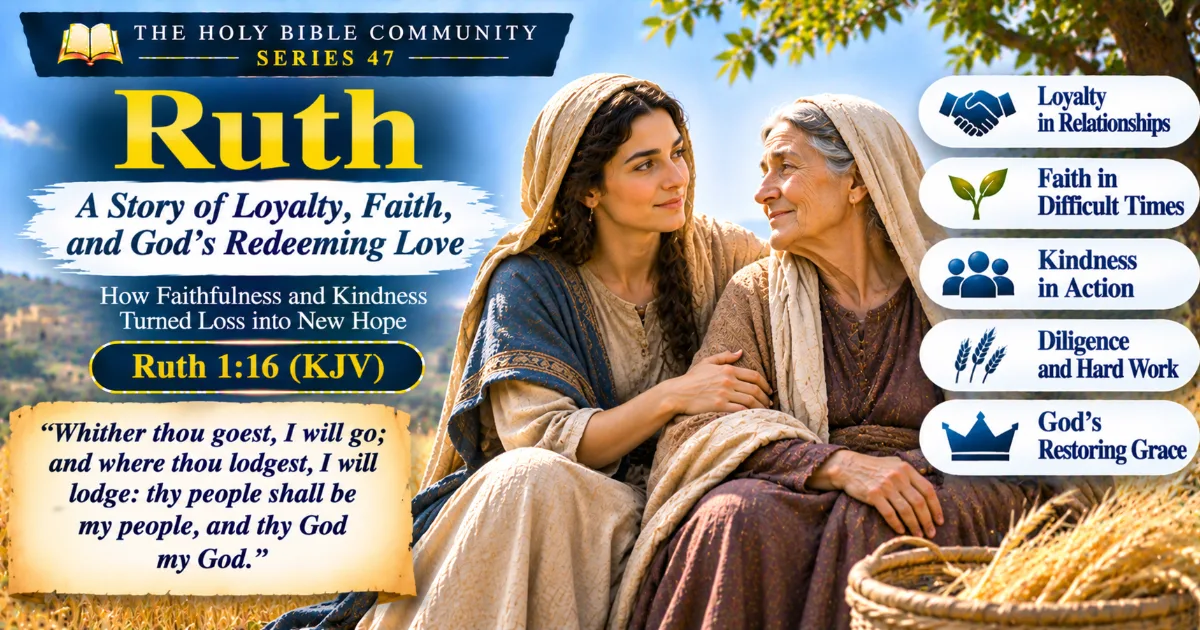
Key Bible Verse: Ruth 1:16 (KJV)
"And Ruth said, Intreat me not to leave thee, or to return from following after thee: for whither thou goest, I will go; and where thou lodgest, I will lodge: thy people shall be my people, and thy God my God."
When Loyalty Becomes an Expression of Faith
Some of the most meaningful moments in life happen when we choose to remain faithful to someone during a season of uncertainty. Loyalty is easy when relationships are comfortable, circumstances are favourable, and there is something to gain. It becomes much more difficult when life brings disappointment, loss, financial hardship, or an uncertain future.
The biblical story of Ruth is a beautiful account of loyalty, courage, humility, and God's providence. It is a story about a woman who faced devastating loss but refused to abandon the person who needed her. Ruth's decision to remain with her mother-in-law, Naomi, changed the direction of both their lives. What began as a journey of grief eventually became a story of restoration, belonging, and redemption.
Continue Reading
The Book of Ruth is relatively short, containing only four chapters, but its spiritual lessons are profound. It takes place during the time of the judges, a period when Israel experienced considerable moral and spiritual instability. Against this background, the story presents ordinary people whose choices reveal extraordinary faithfulness.
Ruth was not a queen, prophet, military leader, or wealthy landowner. She was a Moabite widow who had very little security in the world around her. Yet her faithfulness became part of a much greater story in God's plan.
Her journey reminds us that our circumstances do not determine our worth, that kindness can transform lives, and that God can work through ordinary decisions in ways we may not immediately understand.
A Family Forced to Leave Bethlehem
The story begins during a period of famine in Bethlehem, a town in Judah. A man named Elimelech lived there with his wife, Naomi, and their two sons, Mahlon and Chilion.
Because of the famine, Elimelech decided to move his family to the country of Moab. The family left Bethlehem in search of food and a more secure future.
Moab was outside the land of Israel, and the move placed the family in a different cultural and religious environment. While living there, Elimelech died, leaving Naomi a widow with two sons.
The sons eventually married Moabite women. One was named Orpah, and the other was Ruth. For a period of approximately ten years, the family lived in Moab. Then both sons also died.
Naomi was left without her husband or sons. Ruth and Orpah were also widows. The three women faced an uncertain future in a society where family relationships often played an important role in economic and social security.
The opening of Ruth's story is filled with loss. A family that had left Bethlehem hoping to find stability experienced tragedy in a foreign land.
This reminds us that life does not always unfold according to our expectations. People make decisions hoping to improve their circumstances, but unexpected events can change everything. A secure situation can become uncertain, and a season of hope can turn into a season of grief.
The Bible does not hide Naomi's suffering. It presents her pain honestly, allowing readers to understand the emotional weight of what happened.
Naomi Decides to Return Home
After hearing that the LORD had visited His people by giving them bread, Naomi decided to return to Bethlehem. The famine had ended, and she believed it was time to go back to her homeland.
Ruth 1:6 describes how Naomi arose with her daughters-in-law to return from the country of Moab.
The three women began their journey together. However, Naomi soon urged Ruth and Orpah to return to their mothers' houses. She recognised that they were young widows with the possibility of building new lives.
Naomi blessed them and expressed her desire that the LORD would deal kindly with them because they had shown kindness to the dead and to her.
She understood that remaining with her would not necessarily provide them with security. Naomi had no other sons who could become their husbands, and she did not expect to have more children.
Her words reflected the depth of her despair. She believed her future was empty and that the hand of the LORD had gone out against her.
Orpah eventually kissed Naomi goodbye and returned to her people. Ruth, however, refused to leave.
This moment introduces one of the most important decisions in the entire biblical narrative.
Ruth had a choice. She could return to her family, familiar surroundings, and the possibility of beginning again among her own people. Alternatively, she could accompany Naomi into an uncertain future in a land where she would be a foreigner.
She chose loyalty.
Ruth's Extraordinary Declaration of Loyalty
Ruth 1:16 contains one of the most memorable declarations of commitment in Scripture.
Ruth told Naomi not to ask her to leave or return from following her. She promised to go wherever Naomi went, live wherever Naomi lived, and make Naomi's people her people. Most importantly, she declared that Naomi's God would be her God.
This was much more than an emotional promise between relatives. Ruth was making a life-changing commitment.
She was leaving behind her homeland and choosing to identify herself with Naomi's people and faith. She was willing to face uncertainty rather than abandon someone who had become important to her.
The declaration reveals several dimensions of genuine loyalty.
First, Ruth's loyalty was personal. She did not remain with Naomi because she expected wealth or social advancement. Naomi had little material security to offer. Ruth remained because she genuinely cared about her.
Second, her loyalty involved sacrifice. She understood that following Naomi would require leaving familiar surroundings and entering a different society.
Third, her decision involved faith. By declaring that Naomi's God would be her God, Ruth expressed a commitment that extended beyond family affection.
Ruth's words teach us that loyalty is not simply about remaining present when circumstances are pleasant. It is about showing faithfulness when doing so requires patience, sacrifice, and genuine concern for another person.
Ruth's Faith and Her New Beginning
Ruth's declaration also marks an important spiritual transition. She was a Moabite woman who chose to follow the God of Israel.
The Bible does not describe every detail of how Ruth came to know the LORD. However, her words demonstrate that she had developed a meaningful commitment to Him.
Her faith was expressed through action. She did not merely speak about belonging to Naomi's God. She travelled with Naomi and began building a new life among His people.
This is an important principle in Christian living. Faith is not only an idea that exists in our thoughts. It influences the decisions we make, the relationships we value, and the way we respond to uncertainty.
Ruth's journey also reminds us that our background does not prevent us from seeking God. She was a foreigner, but her nationality did not make her devotion meaningless. Her place in God's unfolding plan would eventually become significant.
The story challenges people to avoid judging others solely by their background, culture, family history, or previous circumstances. God's grace is not restricted by the boundaries people create.
Returning to Bethlehem During a Season of Grief
When Naomi and Ruth arrived in Bethlehem, the people recognised Naomi. Their return attracted attention, but Naomi's emotional condition was very different from the person who had left years earlier.
She told the women of the town not to call her Naomi, which is associated with pleasantness, but Mara, meaning bitterness.
Naomi explained that she had gone out full and had returned empty. She believed that the Almighty had dealt very bitterly with her.
Her words reveal the emotional depth of her grief. She had lost her husband and both sons. The future she once imagined had disappeared.
Ruth's presence did not immediately remove Naomi's pain. Their relationship was important, but Naomi still needed time to process her losses.
This is an important lesson about supporting people who are grieving. We cannot always remove another person's pain through encouragement or positive words. Sometimes the most meaningful support is simply remaining present.
Ruth did not force Naomi to pretend that everything was fine. She accompanied her through the difficult journey and began helping her rebuild her life.
The Bible allows Naomi to express sadness without presenting her grief as a failure of faith. This reminds us that believers can experience sorrow, confusion, and disappointment while continuing to seek God.
Ruth Begins Working in the Fields
After arriving in Bethlehem, Ruth recognised that she and Naomi needed food. She therefore asked Naomi for permission to go into the fields and glean after someone in whose sight she might find grace.
Gleaning was a practice in ancient Israel that allowed poor people, widows, and strangers to gather grain left behind by harvesters.
The Law of Moses included instructions requiring landowners not to harvest every part of their fields. They were to leave portions for the poor and strangers.
Leviticus 19:9-10 describes this responsibility, instructing landowners not to gather every corner of their fields or collect every remaining grape. These provisions helped vulnerable people obtain food while also encouraging generosity and social responsibility.
Ruth was willing to work. She did not demand that others provide everything for her. She took initiative and sought an opportunity to support herself and Naomi.
Her attitude offers an important lesson about responsibility during difficult seasons. Faith does not mean refusing to act while waiting for circumstances to improve. Trusting God can include taking practical steps, working honestly, and using the opportunities available.
Ruth's willingness to labour demonstrated humility and determination. She was prepared to begin again through ordinary work.
God's Providence in an Ordinary Field
Ruth 2:3 describes how Ruth went out and came to a field belonging to Boaz, who was related to Elimelech, Naomi's deceased husband.
The verse says that her "hap was to light on a part of the field belonging unto Boaz." From Ruth's immediate perspective, she was simply looking for a place where she could gather grain.
Yet the reader can recognise the significance of this encounter. Ruth had entered the field of a man whose role would become central to the future of both women.
The story demonstrates God's providence through ordinary events. There was no dramatic announcement before Ruth entered the field. She simply took the next responsible step, and an important opportunity emerged.
This does not mean every coincidence should automatically be interpreted as a direct message from God. Rather, the narrative invites readers to recognise how God's purposes can unfold through circumstances that initially appear ordinary.
Many important changes in life begin with small decisions. A conversation, an opportunity to work, an act of kindness, or a willingness to begin again may become part of a larger journey.
Ruth did not know everything that would happen when she entered the field. She simply acted faithfully with the opportunity in front of her.
Boaz Notices Ruth's Character
Boaz arrived at his field and greeted the harvesters. He asked about the young woman who was gathering grain.
The servant responsible for the harvesters explained that she was the Moabitish woman who had returned with Naomi. He also described her hard work and her request to glean.
Boaz had already heard about Ruth's kindness toward Naomi. He knew that she had left her parents and homeland to live among people she had not previously known.
Instead of treating Ruth as an outsider, Boaz spoke kindly to her. He encouraged her to remain in his field and stay close to his young women.
He also instructed the young men not to touch her and allowed her to drink from the water vessels prepared for the workers.
Boaz's actions reveal a man who understood that authority should be exercised with responsibility. He did not use Ruth's vulnerable position to take advantage of her. He provided a safe working environment and treated her with dignity.
This is an important lesson for people in positions of influence. Whether someone manages a workplace, owns a business, leads a family, or serves in a community, authority should be used to protect and encourage others rather than exploit them.
A person's true character becomes visible in the way they treat people who have less power or influence.
Ruth Responds With Humility and Gratitude
Ruth was surprised by Boaz's kindness. She fell on her face and bowed herself to the ground, asking why he had shown favour to her even though she was a stranger.
Boaz explained that he had heard about everything she had done for Naomi since the death of her husband. He recognised the sacrifice she had made by leaving her parents and homeland.
In Ruth 2:12, Boaz offered a blessing:
"The LORD recompense thy work, and a full reward be given thee of the LORD God of Israel, under whose wings thou art come to trust."
This statement captures a beautiful image of divine protection. Boaz recognised that Ruth had come to trust in the God of Israel, and he prayed that she would receive His reward.
Ruth's response demonstrates humility. She did not assume that kindness was something she was automatically entitled to receive. She recognised it and expressed gratitude.
Gratitude is an important quality in relationships. When people acknowledge kindness rather than taking it for granted, they strengthen trust and encourage generosity.
Boaz's kindness and Ruth's gratitude created a relationship built on mutual respect.
Naomi Recognises the Significance of Boaz
When Ruth returned home with the grain she had gathered, Naomi asked where she had worked. Ruth explained that the man's name was Boaz.
Naomi immediately recognised the significance of this information. She blessed the LORD and explained that Boaz was a close relative, one of their near kinsmen.
The concept of a kinsman-redeemer was connected to responsibilities within Israelite family and property traditions. A near relative could, under certain circumstances, help preserve family inheritance and protect vulnerable family members.
Naomi understood that Boaz was in a position to play an important role in their future.
Her response also shows a change in her emotional perspective. Earlier, she had described herself as returning empty. Now she was beginning to recognise that there might still be hope.
Her circumstances had not changed completely, but a new possibility had emerged.
This teaches us that hope sometimes returns gradually. A difficult season may not disappear immediately, but one act of kindness or one new opportunity can help people begin to imagine a different future.
Naomi Guides Ruth With Wisdom
As the story develops, Naomi encourages Ruth to consider her future. She wants to find a secure home for her daughter-in-law.
Naomi advises Ruth concerning the appropriate approach to Boaz and the family responsibilities connected with redemption.
The instructions in Ruth chapter 3 belong to the customs and legal traditions of that historical period. They should be understood within their biblical and cultural setting rather than treated as a universal relationship formula.
Ruth follows Naomi's guidance with respect. She approaches Boaz and asks him to spread his garment over her because he is a near kinsman.
The request was connected to the responsibilities of redemption and marriage within their society.
Boaz responds with kindness and recognises Ruth's character. He describes her actions as an expression of kindness and assures her that he will address the matter.
However, he also explains that there is another relative who has a closer legal claim.
This detail is important because Boaz does not simply act according to personal desire. He respects the established order and recognises the other relative's rights.
His conduct reveals patience and integrity. He does not attempt to obtain what he wants through deception or by ignoring a legitimate responsibility.
Boaz Acts With Integrity
Boaz goes to the city gate, where important legal and business matters were handled. He gathers elders as witnesses and speaks with the relative who has the closer right of redemption.
The relative initially expresses willingness to redeem the property associated with Elimelech's family. However, when Boaz explains the additional responsibility involving Ruth, the relative declines.
Boaz then publicly accepts the responsibility.
This scene demonstrates the importance of handling serious matters transparently. Boaz does not secretly arrange an agreement or manipulate the situation. He follows the appropriate process and ensures that witnesses are present.
His behaviour provides a practical example of integrity in agreements and responsibilities.
In modern life, people often face decisions involving property, money, business partnerships, family obligations, and legal commitments. These matters should be handled with honesty and clarity.
A good outcome does not justify dishonest methods. Boaz shows that doing what is right includes respecting established responsibilities, even when the process requires patience.
Ruth and Boaz: A New Chapter Begins
Boaz marries Ruth, and the LORD gives her the ability to conceive. She gives birth to a son.
The women of Bethlehem celebrate with Naomi and recognise that God has not left her without a redeemer.
They bless the LORD and acknowledge the kindness shown to Naomi through the child.
The birth of Ruth's son represents a significant turning point. Naomi, who once believed that she had returned empty, now holds a child who will become central to the future of her family.
The story moves from famine and death toward provision, marriage, family, and renewed hope.
However, the restoration is not presented as a simple replacement for everything Naomi lost. Her husband and sons remain part of her history. The story does not erase grief. Instead, it shows that new life and hope can emerge even after profound loss.
This is a meaningful lesson for people who have experienced disappointment. A new beginning does not require pretending that the past never happened. Healing can involve remembering what was lost while remaining open to what God may bring next.
The Family Line That Led to King David
The final verses of Ruth reveal the broader significance of the story. The child born to Ruth and Boaz was named Obed.
Obed became the father of Jesse, and Jesse became the father of David.
This genealogy connects Ruth's personal story to the larger history of Israel. She became part of the family line from which King David would come.
The significance becomes even greater when the New Testament genealogy of Jesus Christ is considered. Matthew chapter 1 includes Ruth among the women mentioned in the genealogy of Jesus.
A Moabite widow who once faced an uncertain future became part of the biblical account of the ancestry of Christ.
This development highlights the reach of God's grace. Ruth's background did not prevent her from becoming part of an important chapter in the history of redemption.
Her story demonstrates that people who may appear insignificant according to worldly standards can have a meaningful place in God's purposes.
The Bible does not present Ruth as someone who controlled the future or understood every consequence of her decisions. She remained faithful in the circumstances she faced, and her life became part of a story far greater than she could have imagined.
What Ruth Teaches Us About Loyalty
Loyalty is one of the central themes of this book. Ruth's commitment to Naomi was not based on convenience or personal advantage.
She remained when leaving would have been easier. She supported Naomi when both women faced uncertainty. Her actions demonstrated that genuine love includes responsibility and sacrifice.
Modern relationships also require this kind of faithfulness. Families, friendships, and marriages become stronger when people support one another through difficult seasons.
However, loyalty should not be confused with accepting abuse, manipulation, or harmful treatment. Ruth's story describes a relationship in which she chose to remain with someone she loved and support someone who needed her. It should not be used to pressure people into remaining in dangerous situations.
Healthy loyalty is connected with love, dignity, respect, and responsibility.
What Ruth Teaches Us About Hard Work
Ruth's willingness to glean in the fields is another important lesson. She did not allow her circumstances to become an excuse for avoiding responsibility.
She recognised the needs of her household and took practical steps to meet them.
Her work was not glamorous. She was gathering leftover grain in a field, but she performed her task diligently.
This teaches us that meaningful work does not always begin with impressive opportunities. Sometimes progress starts with small responsibilities performed consistently.
People may feel discouraged when their current circumstances do not match their ambitions. Ruth's example reminds us that honest work has dignity, regardless of social status.
Whether someone is studying, searching for employment, caring for family members, building a business, or beginning a new career, faithfulness in ordinary responsibilities matters.
What Ruth Teaches Us About Kindness
The relationship between Ruth, Naomi, and Boaz is built around acts of kindness.
Ruth shows kindness by remaining with Naomi. Boaz shows kindness by protecting Ruth and allowing her to gather grain. Naomi shows kindness by seeking a secure future for Ruth.
These actions demonstrate that kindness is not merely a pleasant feeling. It becomes meaningful through practical decisions.
A kind person notices when someone is struggling, considers what help is possible, and acts with respect.
Kindness can be expressed through providing food, offering guidance, creating a safe environment, giving someone an opportunity, or simply remaining present during a difficult season.
The story also shows that kindness can create a chain of positive influence. Ruth's faithfulness encourages Boaz's generosity, while Boaz's generosity helps restore hope in Naomi's life.
Recognising God's Work in Ordinary Circumstances
One of the most beautiful aspects of the Book of Ruth is the way God's providence is revealed without constant dramatic intervention.
The story contains no recorded miraculous destruction of enemies or spectacular signs. Instead, God's care is seen through a journey, a field, a harvest, a conversation, a family responsibility, and the birth of a child.
This is important because many people expect to recognise God's work only through extraordinary experiences.
Yet the Book of Ruth reminds us that ordinary events can also become meaningful parts of a larger story.
An opportunity to work, a supportive relationship, a timely act of kindness, or a responsible decision may become important in ways we cannot immediately see.
We should remain grateful for ordinary blessings while continuing to seek God's wisdom in our decisions.
Practical Ways to Apply Ruth's Example
Ruth's story offers several lessons that can be applied in everyday life.
First, remain faithful in relationships that are healthy and meaningful. Do not abandon people simply because supporting them becomes inconvenient. Offer genuine care and practical help when possible.
Second, develop the courage to begin again. Ruth left her familiar surroundings and entered an uncertain future. Her story encourages us not to allow past disappointment to destroy every possibility of a new beginning.
Third, take responsibility for your circumstances. Ruth worked diligently to support herself and Naomi. Trust in God should encourage responsible action rather than passivity.
Fourth, treat vulnerable people with dignity. Boaz recognised Ruth's situation and used his position to protect and support her. We should never exploit someone because they have fewer resources or less influence.
Fifth, practise gratitude. Recognise the kindness of others and express appreciation rather than treating their efforts as something ordinary or guaranteed.
Sixth, act with integrity in important decisions. Boaz followed the appropriate process and respected the rights of another relative. Honesty should remain important even when shortcuts appear easier.
Finally, trust that your life can have meaning beyond what you currently understand. Ruth could not have known that her story would become part of the genealogy of Jesus Christ. She simply remained faithful in the responsibilities and relationships before her.
Conclusion: Faithfulness Can Lead to Unexpected Restoration
The story of Ruth begins with famine, death, grief, and uncertainty. It follows two widows as they return to Bethlehem with very little security. Yet through loyalty, hard work, kindness, and God's providence, their story moves toward hope and restoration.
Ruth's declaration to Naomi remains one of the clearest expressions of commitment in Scripture. She chose to remain, to support, and to follow the God of Israel. Her faith was demonstrated through ordinary actions rather than impressive public achievements.
Boaz's character also reminds us that kindness and integrity can change the lives of vulnerable people. His willingness to act responsibly provided security and helped restore hope to Naomi and Ruth.
Most importantly, the Book of Ruth shows that God's purposes can unfold through people whose lives may initially appear ordinary or insignificant. A foreign widow became part of the family line of David and, ultimately, the genealogy of Jesus Christ.
There may be times when we cannot understand why a difficult season has entered our lives. We may experience loss, disappointment, uncertainty, or the feeling that our future has become smaller than we imagined.
Ruth's story encourages us to remain faithful, continue doing what is right, show kindness to others, and trust God with the future. We may not see the full meaning of our decisions today, but faithfulness, compassion, and integrity are never wasted.
A Prayer for Loyalty, Faith, and Hope
Heavenly Father, thank You for the beautiful example of Ruth and her loyalty, courage, humility, and faith. Teach me to remain faithful to the people You have placed in my life and to show kindness when others are facing difficult circumstances.
Give me strength when I experience loss, disappointment, and uncertainty. Help me find the courage to begin again when life takes an unexpected direction. Guide my decisions and teach me to work honestly, act with integrity, and treat every person with dignity.
Help me recognise the ordinary blessings You provide and remain grateful for the kindness of others. Protect me from selfishness, bitterness, pride, and discouragement.
When I cannot understand what lies ahead, help me trust Your wisdom and remain faithful in the responsibilities before me. May my life reflect Your love through my words, decisions, and actions.
Thank You for reminding me through Ruth's story that no person is insignificant in Your sight and that Your grace can reach beyond every boundary.
In Jesus Christ's name, I pray. Amen.
#TheHolyBible #BookOfRuth #FaithAndLoyalty #GodsRedeemingLove #BiblicalWisdom