
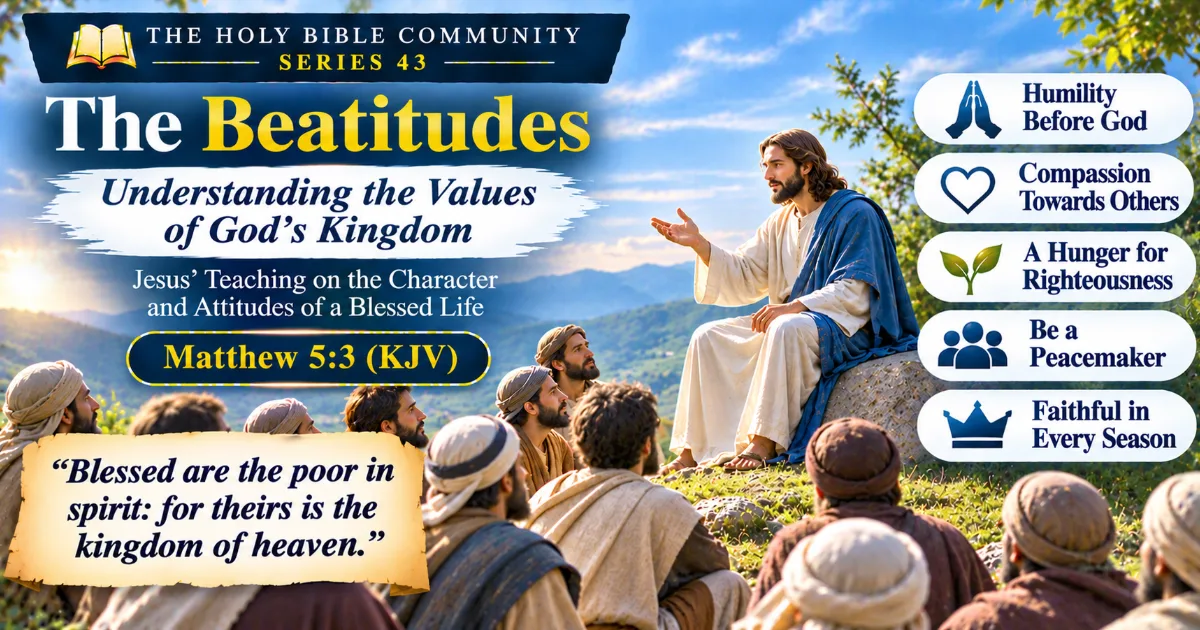
The teachings of Jesus Christ challenge many of the values that people commonly use to measure success, happiness, and greatness. The world often celebrates wealth, influence, popularity, power, and personal achievement. People are encouraged to become stronger than their competitors, protect their own interests, seek recognition, and avoid anything that might make them appear weak. Yet when Jesus began teaching His disciples and the crowds gathered around Him on a mountainside, He presented a very different understanding of what it means to live a blessed life.
In Matthew 5:1-12, Jesus introduced a series of teachings known as the Beatitudes. These statements describe the character, attitudes, and spiritual qualities that belong to people who live according to the values of God's Kingdom. He spoke about the poor in spirit, those who mourn, the meek, those who hunger and thirst after righteousness, the merciful, the pure in heart, the peacemakers, and those who are persecuted for righteousness' sake.
At first glance, some of these statements may seem surprising. Why would Jesus describe people who mourn as blessed? Why would the meek inherit the earth rather than the powerful? How can people who are persecuted be considered blessed? These teachings challenge the assumption that happiness depends on favourable circumstances, social position, or material possessions.
The Beatitudes do not promise that followers of Christ will never experience sadness, injustice, rejection, or hardship. Instead, they reveal that God's understanding of blessing is deeper than outward comfort. A person can experience difficulty and still possess a meaningful relationship with God. A person can have little worldly recognition and still be rich in spiritual character.
The Beatitudes also show us what Christian character should look like in everyday life. They are not simply beautiful statements to memorise. They are principles that should influence how we think, speak, make decisions, treat others, respond to injustice, and relate to God.
Continue Reading
Understanding the Beatitudes helps us recognise that following Jesus is not merely about religious identity. It is about allowing His teachings to transform our hearts and shape the way we live.
Understanding the Sermon on the Mount
The Beatitudes appear at the beginning of the Sermon on the Mount, recorded in Matthew chapters 5, 6, and 7. This sermon is one of the most important collections of Jesus' teachings in the New Testament.
Matthew 5:1-2 (KJV) introduces the setting:
"And seeing the multitudes, he went up into a mountain: and when he was set, his disciples came unto him: And he opened his mouth, and taught them, saying,"
Jesus was teaching His disciples while a larger crowd was also present. His message explained the character and conduct expected of those who belonged to the Kingdom of Heaven.
The sermon addresses subjects such as anger, forgiveness, love for enemies, prayer, generosity, worry, judging others, and the importance of putting God's will into practice.
The Beatitudes establish the spiritual foundation for these teachings. Before explaining many specific actions, Jesus describes the kind of heart that should guide His followers.
They reveal that the Kingdom of God is not built upon pride, aggression, selfish ambition, or the pursuit of recognition. It is characterised by humility, mercy, righteousness, purity, peace, and faithfulness.
The teachings also challenge religious behaviour that focuses only on outward appearances. A person may appear respectable while harbouring hatred, jealousy, dishonesty, or pride within the heart. Jesus repeatedly teaches that genuine righteousness must begin inwardly and become visible through our actions.
What Does Blessed Mean?
The word "blessed" appears repeatedly in the Beatitudes. In everyday language, people often associate blessings with financial success, good health, favourable circumstances, or the achievement of personal goals.
These things can certainly be received with gratitude. However, Jesus uses the language of blessing in a deeper spiritual sense.
To be blessed is to stand in a favourable relationship with God and experience the hope, purpose, and spiritual benefits associated with His Kingdom.
This does not mean that every blessed person will have an easy life. The Beatitudes themselves make clear that people who follow God may experience mourning, persecution, and rejection.
The important distinction is that worldly circumstances do not determine the ultimate value of a person's life. God's presence, promises, and purposes remain meaningful even when life becomes difficult.
A person who is poor in material possessions may still possess spiritual riches. Someone who is grieving may still receive divine comfort. Someone who is treated unjustly may remain faithful to righteousness.
The Beatitudes invite us to evaluate our lives through God's perspective rather than relying entirely on society's definition of success.
The First Beatitude: Blessed Are the Poor in Spirit
Matthew 5:3 (KJV) says:
"Blessed are the poor in spirit: for theirs is the kingdom of heaven."
Being poor in spirit does not mean lacking confidence, intelligence, ability, or personal dignity. It describes a person who recognises their spiritual need before God.
Such a person understands that human beings cannot become righteous through pride or self-sufficiency. They recognise their dependence on God's grace, wisdom, and mercy.
Spiritual humility is different from believing that we have no value. God created human beings with dignity, and humility does not require us to deny the abilities or responsibilities He has given us. Instead, it means acknowledging that everything we have ultimately depends upon Him.
A person who is poor in spirit does not approach God with the attitude that they deserve every blessing. They come with a humble heart, recognising their need for forgiveness and guidance.
This attitude also influences relationships with other people. Humble individuals are generally more willing to listen, admit mistakes, learn from correction, and recognise the contributions of others.
Pride makes people defensive and unwilling to change. Humility creates room for growth.
In practical life, being poor in spirit means approaching difficult decisions with prayer rather than assuming that personal knowledge is always sufficient. It means accepting correction without immediately becoming angry and recognising that success does not make us superior to others.
Jesus declares that the Kingdom of Heaven belongs to such people because they recognise their need for God.
The Second Beatitude: Blessed Are They That Mourn
Matthew 5:4 (KJV) says:
"Blessed are they that mourn: for they shall be comforted."
Mourning is usually associated with sadness, grief, disappointment, and loss. People naturally try to avoid painful experiences, and there is nothing wrong with seeking relief from suffering.
However, Jesus teaches that those who mourn are not forgotten by God. Their pain does not place them outside the reach of His comfort.
This statement includes people who grieve because of death, illness, broken relationships, injustice, or other painful circumstances. It also points towards the sorrow associated with recognising sin and the brokenness of the world.
There is a difference between ignoring wrongdoing and feeling genuine sorrow when we recognise that we have acted against God's will. A heart that is sensitive to sin does not treat harmful behaviour as insignificant.
When we recognise that our words have wounded someone, that our decisions have caused harm, or that we have allowed selfishness to control us, sorrow can lead us towards repentance and change.
The promise of comfort does not mean that every painful situation will disappear immediately. Grief can take time, and people may need emotional support, practical assistance, and the companionship of others.
God's comfort can reach people through prayer, Scripture, loving relationships, and the hope found in Christ.
This Beatitude reminds us not to dismiss those who are grieving. Sometimes the most meaningful expression of compassion is to listen, remain present, and help someone carry a difficult burden.
The Third Beatitude: Blessed Are the Meek
Matthew 5:5 (KJV) says:
"Blessed are the meek: for they shall inherit the earth."
Meekness is often misunderstood as weakness or an inability to defend oneself. Biblical meekness is better understood as strength guided by humility, patience, and self-control.
A meek person does not need to dominate every conversation, win every argument, or prove superiority over others. Such a person can possess strength and conviction without becoming arrogant or aggressive.
Jesus Himself provides the central example of meekness. Matthew 11:29 (KJV) records His words:
"Take my yoke upon you, and learn of me; for I am meek and lowly in heart: and ye shall find rest unto your souls."
Meekness does not require accepting injustice as though it were good. It does not mean remaining silent when someone is being harmed or refusing to establish appropriate boundaries. Instead, it teaches us to respond without allowing anger, pride, or revenge to control our behaviour.
In family relationships, meekness can mean listening carefully during disagreements instead of shouting to establish authority. At work, it can mean responding to criticism with maturity rather than immediately attacking the person who offered it.
In public life, meekness encourages responsible leadership that serves people rather than exploiting them.
The promise that the meek shall inherit the earth challenges the belief that everything belongs to those who are most aggressive. Jesus points towards God's ultimate justice, in which humility and faithfulness matter more than worldly domination.
The Fourth Beatitude: Blessed Are They Which Hunger and Thirst After Righteousness
Matthew 5:6 (KJV) says:
"Blessed are they which do hunger and thirst after righteousness: for they shall be filled."
Hunger and thirst are powerful images because they describe essential human needs. Jesus uses them to explain the intensity with which His followers should desire righteousness.
Righteousness involves living in accordance with God's character and will. It includes honesty, justice, faithfulness, purity, compassion, and obedience.
To hunger and thirst after righteousness means wanting more than a respectable appearance. It means sincerely desiring a life that pleases God.
A person who desires righteousness does not ask only whether an action is legal, profitable, or socially acceptable. They also consider whether it is honest, just, compassionate, and consistent with biblical principles.
This Beatitude has personal and social dimensions. We should desire righteousness in our own behaviour, but we should also care about justice and truth in the world around us.
For example, a business owner who values righteousness will not knowingly deceive customers simply to increase profits. An employee who values righteousness will not falsify information to gain recognition. A leader who values righteousness will consider the well-being of people rather than using authority for personal benefit.
Hungering for righteousness also requires consistency. It is easy to speak about honesty when dishonesty offers no advantage. The real test comes when doing what is right requires sacrifice.
Jesus promises that those who sincerely desire righteousness will be filled. This points to God's work in transforming people and ultimately bringing His righteous purposes to completion.
The Fifth Beatitude: Blessed Are the Merciful
Matthew 5:7 (KJV) says:
"Blessed are the merciful: for they shall obtain mercy."
Mercy is the willingness to respond to another person's suffering or failure with compassion rather than cruelty.
It does not mean pretending that wrongdoing is harmless. Instead, mercy recognises the dignity of people even when they have made mistakes.
The Bible repeatedly teaches that God is merciful. Human beings depend upon His mercy because none of us lives without failure.
When we understand how much mercy we need, it becomes harder to justify treating others with unnecessary harshness.
Mercy can appear in many ordinary situations. It may involve patiently helping someone who is struggling, refusing to spread humiliating information about another person, giving someone an opportunity to correct an honest mistake, or supporting a person who has experienced hardship.
Mercy also influences how we respond to disagreement. We can disagree with someone's decisions without treating them as though they have no value.
However, mercy must be accompanied by wisdom. It does not require allowing repeated abuse, enabling destructive behaviour, or abandoning accountability. A merciful response can include firm boundaries and a clear expectation that wrongdoing must stop.
The central lesson is that people who have received mercy should become willing to show mercy.
The Sixth Beatitude: Blessed Are the Pure in Heart
Matthew 5:8 (KJV) says:
"Blessed are the pure in heart: for they shall see God."
Purity of heart concerns the inner life of a person. It involves sincerity, integrity, truthfulness, and freedom from the hidden motives that contradict outward religious behaviour.
A person may perform good actions while secretly seeking admiration, financial advantage, or control over others. Outward behaviour can sometimes hide inward selfishness.
Jesus teaches that God is concerned with the heart, not merely the appearance of righteousness.
Purity does not mean that a person has never experienced temptation or struggled with wrong desires. It means seeking to align the inner life with God's truth and resisting the attitudes that lead towards sin.
This requires regular self-examination. We should consider why we are making certain decisions, whether we are being honest with others, and whether our private conduct reflects the values we publicly profess.
For example, helping someone only because we expect a reward is different from helping because we genuinely care. Speaking about forgiveness while secretly planning revenge reveals a divided heart.
Purity also involves protecting the mind from influences that encourage hatred, dishonesty, exploitation, and harmful desires.
Prayer, Scripture, confession, and accountability can help believers examine their motives and seek God's transformation.
The promise that the pure in heart shall see God expresses the importance of sincere relationship with Him and the hope of knowing His presence more fully.
The Seventh Beatitude: Blessed Are the Peacemakers
Matthew 5:9 (KJV) says:
"Blessed are the peacemakers: for they shall be called the children of God."
Peacemakers are people who actively work towards reconciliation, understanding, and harmony.
There is an important difference between being a peacemaker and simply avoiding conflict. Sometimes people remain silent because they fear disagreement. Others pretend that a serious problem does not exist because addressing it would be uncomfortable.
True peace is not created by hiding injustice or ignoring harmful behaviour. It requires honesty, fairness, humility, and a willingness to address problems constructively.
A peacemaker seeks solutions rather than opportunities to increase hostility.
In families, this may involve encouraging respectful conversations between relatives who have misunderstood one another. In workplaces, it may mean helping colleagues resolve disagreements through communication and fairness. In communities, it may involve resisting rumours, discrimination, and unnecessary hostility.
Peacemaking also requires self-control. We should think carefully before speaking, especially when emotions are strong.
Proverbs 15:1 (KJV) teaches:
"A soft answer turneth away wrath: but grievous words stir up anger."
A gentle response can sometimes prevent a disagreement from becoming a serious conflict. However, gentleness does not mean avoiding necessary truth.
Peacemakers are willing to speak honestly while treating others with dignity.
Jesus calls such people the children of God because their actions reflect the character of their heavenly Father.
The Eighth Beatitude: Blessed Are They Which Are Persecuted for Righteousness' Sake
Matthew 5:10 (KJV) says:
"Blessed are they which are persecuted for righteousness' sake: for theirs is the kingdom of heaven."
This Beatitude may be one of the most challenging because it acknowledges that doing what is right can bring opposition.
People who refuse to participate in dishonesty, corruption, exploitation, or injustice may face criticism or personal disadvantage. Those who remain faithful to Christ may also experience rejection because of their beliefs.
Jesus does not suggest that suffering itself is desirable or that every disagreement should be interpreted as persecution. People may face criticism because of their own mistakes, arrogance, or unkind behaviour.
The promise applies specifically to those who experience opposition because they remain committed to righteousness.
This distinction matters. Christians should not use the language of persecution to avoid accountability for harmful actions. Instead, they should examine their conduct honestly while remaining faithful when genuine opposition arises because of doing what is right.
For example, an employee who refuses to falsify financial records may face pressure from colleagues. A student who refuses to cheat may be mocked by classmates. A person who stands against discrimination may encounter hostility from those who benefit from unfair treatment.
In such situations, remaining faithful can require courage.
Jesus reminds His followers that their ultimate reward is not determined by the approval of society. Their relationship with God remains more important than temporary recognition.
The Ninth Beatitude: Rejoicing When Persecuted for Christ
Matthew 5:11-12 continues the teaching:
"Blessed are ye, when men shall revile you, and persecute you, and shall say all manner of evil against you falsely, for my sake."
"Rejoice, and be exceeding glad: for great is your reward in heaven: for so persecuted they the prophets which were before you."
Here Jesus makes the teaching personal by addressing His disciples directly.
He prepares them for the possibility that following Him will bring criticism, false accusations, and hostility. Their faithfulness may place them in situations where others misunderstand or reject them.
Jesus connects their experience with the prophets who came before them. Many prophets faced opposition because they delivered messages that challenged injustice, idolatry, and disobedience.
The instruction to rejoice does not mean that Christians should enjoy pain or pretend that suffering is pleasant. It means that opposition does not cancel the spiritual significance of remaining faithful to Christ.
Their hope is greater than temporary approval.
This teaching also encourages believers to respond to hostility without becoming hostile themselves. We should not repay false accusations with dishonesty, hatred, or revenge.
Faithfulness includes maintaining integrity even when others behave unfairly.
The Beatitudes as a Complete Picture of Christian Character
The Beatitudes should not be treated as unrelated statements that describe separate groups of people. Together, they present a connected picture of the character that Jesus desires His followers to develop.
Poverty of spirit teaches humility before God. Mourning reveals sensitivity to suffering and sin. Meekness teaches strength under control. Hunger for righteousness creates a desire to live according to God's will.
Mercy influences how we treat those who have failed or suffered. Purity of heart concerns our motives and inner character. Peacemaking guides our relationships. Faithfulness under persecution demonstrates commitment when following Christ becomes difficult.
These qualities support one another.
A person who seeks righteousness without mercy may become harsh and judgmental. Someone who desires peace without truth may simply avoid necessary conversations. Someone who speaks about humility while seeking constant recognition has not fully understood the teaching.
The Beatitudes therefore call for a transformed life in which our attitudes and actions reflect the same spiritual foundation.
Applying the Beatitudes in Modern Life
The teachings of Jesus remain relevant in every generation because human struggles involving pride, anger, injustice, selfishness, and the desire for recognition have not disappeared.
In modern workplaces, the Beatitudes encourage honesty, humility, fairness, and respect. A manager can demonstrate meekness by using authority responsibly. An employee can demonstrate righteousness by refusing dishonest practices. Colleagues can become peacemakers by addressing disagreements constructively instead of spreading rumours.
In families, these teachings encourage patience, forgiveness, compassion, and sincere communication. Parents can guide children without humiliating them. Children can learn to respect others while developing the confidence to express their concerns appropriately. Family members can seek reconciliation while maintaining necessary boundaries where harm has occurred.
In digital spaces, the Beatitudes challenge people to consider how they communicate. Social media can encourage anger, comparison, public humiliation, and hostility. A person seeking purity of heart should examine the content they consume and share. A peacemaker should resist spreading unverified accusations. A merciful person should remember that people deserve dignity even during disagreement.
In leadership, the Beatitudes challenge the idea that influence should be used for personal advantage. Leaders who value humility and righteousness consider the needs of those affected by their decisions. They accept responsibility, communicate honestly, and resist the temptation to misuse authority.
In personal life, the Beatitudes encourage us to measure progress through spiritual character rather than comparison with others. Wealth and recognition may change, but humility, integrity, compassion, and faithfulness remain valuable.
How to Develop the Character Described in the Beatitudes
Developing these qualities is a lifelong process. We should not assume that reading the Beatitudes once will automatically transform our behaviour. Their teachings must be reflected upon and practised.
Begin with honest self-examination. Consider whether pride, anger, jealousy, dishonesty, or resentment is influencing your decisions. Recognising these attitudes allows you to seek God's help in changing them.
Make time for Scripture and prayer. The teachings of Jesus provide guidance for situations that require wisdom and self-control. Regular reflection can help us recognise where our behaviour needs correction.
Practise humility by listening carefully and admitting mistakes. Do not treat every disagreement as a personal attack. Learn to accept correction when it is justified.
Show mercy through practical actions. Offer assistance where possible, speak respectfully, and avoid using another person's mistakes as an opportunity for humiliation.
Pursue peace without abandoning truth. Address conflicts honestly and seek solutions that respect the dignity and legitimate needs of everyone involved.
Remain committed to righteousness when doing what is right becomes inconvenient. Do not allow pressure, popularity, or personal advantage to become more important than your convictions.
Finally, remember that spiritual growth is not a competition. The purpose is not to appear more righteous than other people. It is to become more faithful to Christ and allow His teachings to shape our character.
The Beatitudes and the Hope of God's Kingdom
The Beatitudes repeatedly connect present spiritual qualities with future promises. The poor in spirit receive the Kingdom of Heaven. Those who mourn will be comforted. The meek will inherit the earth. Those who hunger for righteousness will be filled.
The merciful will obtain mercy, the pure in heart will see God, and the peacemakers will be called the children of God.
Jesus also promises the Kingdom of Heaven to those persecuted for righteousness' sake.
These promises reveal that God's Kingdom offers a hope that extends beyond present circumstances. Human recognition, material possessions, and social status are temporary. God's purposes are greater than the changes and difficulties of earthly life.
The Beatitudes encourage believers to remain faithful because their lives are connected to something greater than immediate success.
They also remind us that the values of God's Kingdom should influence the present. We should not wait for a future reward before practising humility, mercy, justice, and peace. These qualities should become visible in our lives today.
Conclusion: Living According to the Values of God's Kingdom
The Beatitudes present a different understanding of what it means to be truly blessed. Jesus does not identify blessing only with wealth, comfort, popularity, or worldly achievement. He describes the spiritual qualities that reflect a life connected to God.
He calls us to humility rather than pride, compassion rather than cruelty, meekness rather than aggression, righteousness rather than selfishness, mercy rather than condemnation, purity rather than hypocrisy, and peace rather than hostility.
He also reminds us that faithfulness may involve opposition. Following Christ does not guarantee an easy life, but it provides a lasting foundation of hope and purpose.
The Beatitudes challenge us to examine our hearts. Are we seeking recognition more than righteousness? Do we show mercy to people who have made mistakes? Do we create peace or increase conflict? Are our private motives consistent with our public beliefs? Do we remain faithful when doing what is right becomes difficult?
These questions help us move beyond simply knowing the words of Jesus towards practising His teachings.
A life shaped by the Beatitudes may not always receive the approval of the world. It may not appear powerful according to ordinary measures of success. Yet it reflects the values of God's Kingdom.
May we seek to become people who are humble before God, compassionate towards others, sincere in our faith, committed to righteousness, and willing to make peace wherever possible.
A Prayer for Living the Beatitudes
Heavenly Father, thank You for the teachings of Jesus Christ and for showing me what it means to live according to the values of Your Kingdom.
Lord, teach me to be poor in spirit, recognising my need for Your wisdom, grace, and guidance. Remove pride from my heart and help me approach You with humility.
Comfort those who are mourning, suffering, or carrying burdens that others cannot see. Give me a compassionate heart so that I may support people who are experiencing difficult seasons.
Teach me to be meek, patient, and self-controlled. Help me respond to disagreements with wisdom instead of anger and to use whatever strength or influence I have to serve others.
Create in me a deep hunger for righteousness. Help me choose honesty over personal advantage, justice over selfishness, and faithfulness over temporary approval.
Make me merciful towards those who are struggling. Give me the wisdom to forgive, the courage to establish healthy boundaries, and the humility to remember that I also depend upon Your mercy.
Purify my heart and remove dishonest motives, jealousy, bitterness, and hypocrisy. Let my private life reflect the faith I profess publicly.
Make me a peacemaker. Help me bring understanding where there is conflict, speak truth with kindness, and avoid words or actions that unnecessarily hurt others.
When I face criticism or opposition because I choose to follow Your ways, strengthen my faith. Help me remain faithful without responding with hatred or revenge.
May the Beatitudes become more than words I read. Let them shape my thoughts, decisions, relationships, and daily actions.
Guide me to live in a way that honours You and reflects the character of Jesus Christ.
In His precious name, I pray.
Amen.
#TheBeatitudes #SermonOnTheMount #TeachingsOfJesus #ChristianLiving #KingdomOfGod