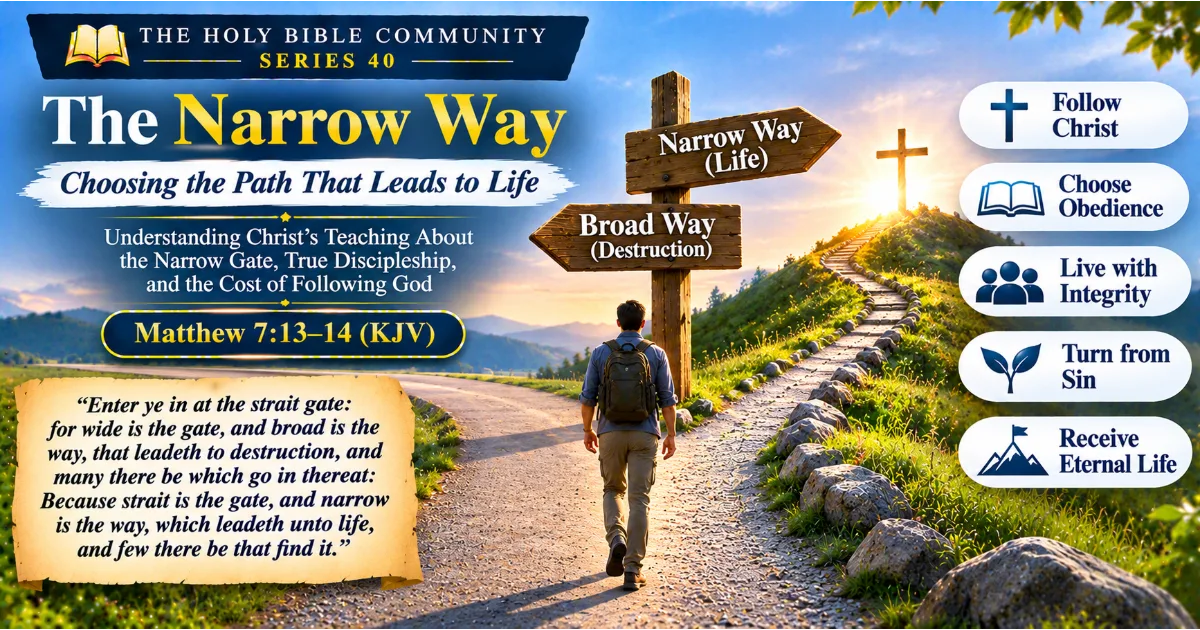
Understanding Christ's Teaching About the Narrow Gate, True Discipleship, and the Cost of Following God
Main Scripture: Matthew 7:13-14 (KJV)
“Enter ye in at the strait gate: for wide is the gate, and broad is the way, that leadeth to destruction, and many there be which go in thereat: Because strait is the gate, and narrow is the way, which leadeth unto life, and few there be that find it.”
Not Every Popular Path Leads to the Right Destination
Every day, we make choices that influence the direction of our lives. Some decisions seem small, such as how we spend our time, what we say during a conversation, or how we respond when someone disagrees with us. Other decisions have deeper consequences, influencing our relationships, values, responsibilities, and spiritual journey.
Continue Reading
In many situations, the easiest option appears to be the most attractive. We may prefer comfort over responsibility, approval over truth, immediate satisfaction over long-term wisdom, and personal convenience over obedience. When many people choose the same direction, it can also become tempting to assume that the popular choice must be the right one.
However, Jesus Christ teaches a different lesson in Matthew 7:13-14. He describes two gates and two paths. One is broad and leads to destruction, while the other is narrow and leads to life. The broad path attracts many people, while the narrow path is found by fewer.
This teaching challenges us to examine the direction of our lives rather than simply following what appears easy or popular. It reminds us that the number of people choosing a particular path does not determine whether that path is right.
The narrow way represents the life of genuine discipleship. It involves trusting Christ, accepting His teachings, turning away from sin, and choosing obedience even when doing so requires sacrifice. It is not always the easiest way, but Jesus teaches that it leads to life.
Following the narrow way does not mean earning salvation through personal effort. Salvation is God's gift through Jesus Christ. Rather, genuine faith produces a life that increasingly reflects His teachings. The narrow way describes the direction of a person who has chosen to follow Christ rather than allowing worldly desires to determine every decision.
This article explores the meaning of the two gates, why the narrow way matters, the challenges believers may face, and how we can remain faithful to Christ in a world that often encourages us to choose the easier path.
Understanding the Context of Matthew 7:13-14
Matthew 7:13-14 appears near the conclusion of the Sermon on the Mount, one of the most important collections of Jesus' teachings.
Throughout Matthew chapters 5, 6, and 7, Jesus explains the character and responsibilities of those who belong to God's kingdom. He teaches about humility, righteousness, mercy, forgiveness, prayer, generosity, trust in God, and the importance of living according to His commandments.
He challenges outward religious appearances that are not supported by genuine inward faith. He warns against hypocrisy, encourages believers to examine their own behaviour, and teaches the importance of treating others with fairness and love.
Towards the end of the sermon, Jesus presents a series of contrasts that require His listeners to make serious decisions. He speaks about two gates, two kinds of trees, two foundations, and two possible outcomes.
These comparisons reveal that listening to His teaching is not enough. People must decide whether they will actually follow it.
The narrow gate and broad gate therefore form part of a larger message about the importance of putting Christ's words into practice. Jesus is not simply offering an interesting observation about different lifestyles. He is calling people to recognise the seriousness of their spiritual choices.
The teaching also reminds us that religious familiarity does not automatically mean genuine discipleship. A person may know biblical language, participate in religious activities, or associate with believers while still refusing to follow Christ's instructions.
Jesus calls for a faith that influences the entire direction of life.
What Is the Broad Way?
Jesus describes the broad way as a path that leads to destruction. It is broad because it accommodates the desires and behaviours of people who choose to live without submitting to God's authority.
The broad way can be attractive because it often requires fewer restrictions. People may choose whatever seems personally satisfying without carefully considering whether their decisions are consistent with God's teachings.
It can include dishonesty for personal advantage, selfish ambition, uncontrolled anger, greed, exploitation, pride, immorality, and the pursuit of pleasure without responsibility.
Not every person following the broad way consciously believes that they are rejecting God. Some may simply follow the habits and expectations surrounding them. Others may assume that because a particular behaviour is common, it must be acceptable.
However, Jesus warns that a path should not be judged only by how comfortable it feels or how many people are travelling on it. Its destination matters.
For example, dishonesty may appear to provide a quick advantage in a business situation. Yet repeated dishonesty damages trust, harms others, and weakens personal character. A person may gain something temporarily while moving further away from the values God teaches.
Similarly, choosing revenge may feel satisfying after being hurt, but it can deepen bitterness and create further conflict. The broad way often offers immediate gratification without encouraging people to consider the spiritual and moral consequences of their decisions.
The warning is not intended to make believers suspicious of every ordinary activity or human enjoyment. It is a call to examine whether our lives are being directed by selfish desires or by the truth of God.
What Does the Narrow Gate Represent?
The narrow gate represents the entrance into the life of genuine discipleship. It requires a decision to follow Jesus Christ and accept His authority.
The narrow gate is not a system through which people earn salvation by becoming sufficiently good. Scripture teaches that salvation comes through God's grace and is received through faith in Jesus Christ. Ephesians 2:8-9 makes this clear by explaining that salvation is the gift of God and not the result of works.
The narrow gate therefore points towards a life that begins with genuine faith and continues through obedience to Christ.
Entering through this gate means recognising our need for God's grace. It means turning away from the belief that personal desires should have unlimited authority over our lives. It means accepting that Christ's teachings are not merely suggestions to consider when convenient.
The narrow gate also challenges pride. A person cannot sincerely follow Christ while insisting that personal ambition, social approval, or worldly success must always come first.
Following Jesus requires humility. We acknowledge that we need His forgiveness, wisdom, and guidance. We accept that our understanding is limited and that His truth must shape our decisions.
The narrow gate is therefore not about making life unnecessarily difficult. It is about choosing the right foundation and entering a relationship with Christ that changes the direction of our lives.
Why Is the Narrow Way Difficult?
Jesus describes the narrow way as difficult because it requires a life of commitment, discipline, and obedience. The values of Christ do not always agree with the desires of human nature or the expectations of society.
There are situations in which doing what is right may involve personal inconvenience. Telling the truth may cost us an opportunity. Forgiving someone may challenge our pride. Refusing an unethical advantage may affect our immediate financial benefit. Remaining faithful to biblical principles may bring criticism from people who disagree with us.
These experiences reveal that discipleship is more than accepting beliefs intellectually. It involves allowing those beliefs to influence real decisions.
The narrow way also requires us to recognise and confront our weaknesses. It is sometimes easier to criticise other people than to examine our own behaviour. It may be easier to demand forgiveness than to offer it, or to expect patience from others while refusing to practise patience ourselves.
Christ calls His followers to a higher standard of living. This does not mean that believers will become perfect immediately. It means that they should remain committed to spiritual growth and willing to receive correction.
The difficulty of the narrow way is not evidence that God has abandoned us. It reflects the reality that genuine discipleship requires us to place God's will above selfish desires.
Following Jesus Requires More Than Religious Appearance
One of the important lessons of the Sermon on the Mount is that outward religious behaviour cannot replace genuine obedience.
A person may attend worship services, know many Bible verses, participate in religious programmes, and speak frequently about faith. These activities can be valuable, but they do not automatically demonstrate that someone is living according to Christ's teachings.
In Matthew 7:21, Jesus says that not everyone who says unto Him, “Lord, Lord,” shall enter into the kingdom of heaven, but those who do the will of His Father.
This statement is a serious warning against separating religious language from genuine obedience.
Christian faith should influence the way we treat others, handle responsibilities, make decisions, and respond to temptation. If our religious activities do not encourage us to become more truthful, humble, loving, and responsible, we should examine whether we are truly applying what we claim to believe.
The narrow way requires sincerity. It calls us to live our faith privately as well as publicly.
It is not enough to speak about honesty during a religious gathering while practising dishonesty in business. It is not enough to discuss forgiveness while deliberately holding on to hatred. It is not enough to praise humility while treating others with arrogance.
Genuine discipleship becomes visible through consistent behaviour.
The Narrow Way Requires Repentance
Repentance is an essential part of following Christ. It involves recognising sin, acknowledging wrongdoing, and turning towards God.
Many people want the comfort of faith without changing the behaviours that damage their relationship with God and others. However, the teachings of Jesus call for a genuine response to sin.
Repentance is more than feeling regret after experiencing negative consequences. It involves recognising that our actions have been wrong and becoming willing to change direction.
For example, a person who has repeatedly lied may feel sorry when the dishonesty is discovered. Genuine repentance involves more than regretting the loss of reputation. It includes acknowledging the wrongdoing, seeking forgiveness, correcting the situation where possible, and making a sincere effort to become truthful.
A person who has treated others unfairly should not simply ask God for forgiveness while continuing the same behaviour without concern. Repentance should lead towards a changed direction.
This process may require time, prayer, accountability, and practical support. Old habits may not disappear immediately, but believers should remain willing to confront them rather than protecting them with excuses.
The narrow way is a path of continued growth. It requires humility to admit when we are wrong and faith to keep moving towards what is right.
Choosing Truth When Dishonesty Appears Easier
One of the most common challenges of the narrow way is the temptation to compromise truth for personal benefit.
Dishonesty can appear attractive when someone believes that telling the truth will create difficulties. A person may exaggerate qualifications to obtain a job, mislead customers to increase sales, conceal important information to avoid responsibility, or take credit for another person's work.
These choices may produce temporary advantages, but they conflict with biblical principles.
Proverbs 12:22 teaches that lying lips are an abomination to the Lord, while those who deal truly are His delight.
The verse reminds believers that honesty matters to God. Our integrity should not depend entirely on whether dishonesty is likely to be discovered.
Walking the narrow way means choosing truth even when the consequences are inconvenient. It means treating agreements seriously, communicating honestly, and refusing to exploit others for personal advantage.
This principle applies to family relationships, professional responsibilities, education, business, and everyday conversations.
A person who consistently practises honesty develops a foundation of trust. Although honesty may sometimes require courage, it allows us to live without building our lives upon deception.
Choosing Forgiveness Instead of Revenge
Another difficult part of the narrow way is responding to people who have hurt us.
When someone behaves unfairly, breaks our trust, or causes serious disappointment, the desire for revenge may become strong. We may want to return the same treatment or make the other person experience similar pain.
However, Jesus repeatedly taught the importance of forgiveness, mercy, and love.
Matthew 5:44 instructs believers to love their enemies and pray for those who persecute them. This teaching challenges the natural desire to respond to hostility with hostility.
Forgiveness does not mean declaring that wrongdoing is acceptable. It does not require a person to ignore abuse, remove appropriate boundaries, or restore trust without evidence of change. Serious wrongdoing may require accountability and protection.
However, forgiveness means refusing to make hatred and revenge the foundation of our lives. It means bringing our pain before God and seeking the strength to respond without becoming controlled by bitterness.
Sometimes forgiveness is a gradual process. Deep wounds may require time, support, and careful decisions. Nevertheless, believers are called to move towards the mercy demonstrated by Christ.
The narrow way may require us to surrender the desire to retaliate and trust God while taking wise steps to address wrongdoing.
Choosing Humility Instead of Pride
Pride can make the narrow way difficult because it encourages us to place personal importance above truth and responsibility.
A proud person may struggle to admit mistakes, receive advice, apologise, or recognise the contributions of others. They may believe that changing their opinion is a sign of weakness or that acknowledging another person's success reduces their own value.
Jesus demonstrated a different approach. Throughout His ministry, He showed humility through service, compassion, and obedience to the Father.
Philippians 2:5-8 describes the humility of Christ and encourages believers to develop the same attitude. The passage reminds us that Jesus did not use His position for selfish advantage but humbled Himself and became obedient.
This example challenges the way we understand authority and success. Genuine greatness is not simply about controlling others or receiving recognition. It includes the willingness to serve.
Choosing the narrow way means being prepared to learn, acknowledge mistakes, and treat others with dignity. It means recognising that our abilities and opportunities are gifts that should be used responsibly.
Humility allows us to grow because it keeps our hearts open to correction.
The Narrow Way in Family Life
Family relationships provide many opportunities to demonstrate whether we are following Christ's teachings.
It is often easier to appear patient and respectful outside the home than within it. Family members share responsibilities, expectations, and daily experiences. Differences in personality and opinion can create repeated disagreements.
The narrow way calls believers to practise love and responsibility within their homes.
Parents should guide children with patience and fairness. Children should learn to respect their parents and contribute to family responsibilities. Spouses should approach one another with honesty, mutual respect, and a willingness to communicate.
Family members should be willing to apologise when they make mistakes and should avoid allowing pride to turn small disagreements into lasting conflict.
Following Christ does not mean accepting harmful behaviour or remaining in unsafe circumstances. It means responding with wisdom, protecting vulnerable people, and maintaining healthy boundaries while refusing to abandon truth and compassion.
A family that seeks to practise biblical principles can become a place where faith is demonstrated through everyday actions rather than merely discussed.
The Narrow Way in Work and Business
Professional life presents many situations in which believers must decide whether they will follow biblical principles or compromise for personal gain.
Competition, financial pressure, deadlines, and expectations can create difficult choices. Employees may face pressure to misrepresent information, managers may be tempted to treat people unfairly, and business owners may encounter opportunities to increase profits through misleading practices.
The narrow way encourages believers to remain honest and responsible.
Colossians 3:23 teaches that whatever we do should be done heartily, as unto the Lord and not merely to please people.
This principle reminds us that professional responsibilities can be part of our Christian witness. The quality of our work, the way we treat colleagues, and our honesty towards customers all matter.
A believer should not use authority to exploit employees, manipulate customers, or create unfair advantages. Success should be pursued through responsible effort rather than dishonest shortcuts.
The narrow way may sometimes appear less profitable in the short term, but integrity is more important than temporary gain.
The Narrow Way When Society Encourages the Opposite
Believers live in societies where values and expectations are constantly changing. Some popular attitudes may conflict with biblical teachings about truth, relationships, responsibility, and personal conduct.
The challenge is to remain faithful without becoming arrogant or hostile towards people who hold different opinions.
Jesus did not call His followers to treat others with contempt. He taught them to love their neighbours and demonstrate humility. Christians should therefore stand by their convictions while communicating with respect.
Following the narrow way may sometimes bring criticism. People may misunderstand why a believer refuses to participate in certain activities or chooses a different standard of behaviour.
In such situations, the response should be guided by wisdom rather than unnecessary arguments. A believer does not need to turn every disagreement into a confrontation. It is possible to remain firm in faith while treating others with kindness.
The goal is not to prove personal superiority. It is to remain faithful to Christ.
Why the Narrow Way Leads to Life
Jesus clearly states that the narrow way leads to life. This destination is central to the meaning of His teaching.
The broad way may promise immediate satisfaction, but it ultimately leads away from God's purpose. The narrow way directs people towards a life rooted in Christ.
Through faith in Jesus, believers receive salvation and enter into a relationship with God. Their lives begin to reflect new priorities, values, and commitments.
The narrow way leads towards spiritual maturity because it teaches us to depend upon God rather than allowing selfish desires to control us. It encourages truth instead of deception, forgiveness instead of revenge, humility instead of pride, and love instead of hatred.
It also points towards the eternal life promised through Christ. The Christian journey is not limited to temporary achievements or the approval of society. It is connected with God's eternal purpose.
The narrow way is therefore valuable not because it guarantees an easy earthly life, but because it leads towards the life God offers through Jesus Christ.
Practical Ways to Remain on the Narrow Way
Following the narrow way requires daily attention and commitment. The following practices can help believers remain faithful.
Keep Christ at the centre of your life. Remember that discipleship begins with a relationship with Jesus and a willingness to follow His teachings.
Study Scripture regularly. Read the Bible carefully and understand its teachings in context. Allow God's Word to guide your beliefs and decisions.
Examine your choices. Consider whether your actions reflect truth, humility, love, and responsibility or whether they are controlled by selfish desires.
Practise repentance. When you recognise wrongdoing, acknowledge it honestly and take practical steps towards change.
Choose integrity. Refuse dishonest shortcuts, even when they appear to offer temporary advantages.
Forgive with wisdom. Do not allow revenge and bitterness to control your life. Maintain appropriate boundaries when necessary.
Remain humble. Accept correction, acknowledge mistakes, and appreciate the contributions of others.
Be careful about influences. Examine the habits, conversations, and entertainment that shape your thinking and priorities.
Seek wise fellowship. Spend time with believers who encourage faithfulness, accountability, and spiritual growth.
Persevere during difficulties. Do not abandon your commitment to Christ when following His teachings becomes inconvenient or unpopular.
These practices do not purchase salvation. They reflect the desire to live faithfully in response to God's grace.
Conclusion: Choose the Path That Leads to Life
The teaching of Matthew 7:13-14 presents a serious choice. Jesus describes two gates, two paths, and two destinations. One path is broad and attracts many people, while the other is narrow and leads to life.
His words challenge us to examine the direction of our lives. Are we simply following what is popular, convenient, and personally satisfying, or are we allowing God's truth to guide our decisions?
The narrow way is the path of genuine discipleship. It involves trusting Christ, accepting His teachings, turning away from sin, and allowing our faith to influence everyday behaviour.
It will not always be easy. There may be times when honesty costs us an advantage, forgiveness challenges our pride, and obedience requires us to reject something that appears attractive. We may face criticism when our convictions differ from popular expectations.
Yet the destination matters more than temporary convenience.
We should remember that salvation is a gift of God's grace through Jesus Christ, not a reward earned by our efforts. The narrow way is not about proving that we are worthy of salvation. It is about responding to God's grace with genuine faith and a willingness to follow Christ.
We will make mistakes along the journey. When we fail, we should return to God through repentance and continue growing. The important thing is not to become comfortable with a direction that leads away from His teachings.
Let us examine our priorities, relationships, habits, and decisions. Let us refuse to measure truth by popularity or success by material possessions alone. Let us choose integrity when dishonesty appears easier, humility when pride becomes attractive, and compassion when anger demands control.
May our lives reflect the teachings of Jesus Christ. May we remain faithful when the path becomes difficult, humble when we succeed, and courageous when we face opposition.
The narrow way may not be the easiest path, but Jesus teaches that it leads to life. Let us choose to follow Him with faith, obedience, and perseverance.
A Prayer for Strength to Follow the Narrow Way
Heavenly Father,
Thank You for showing us the way of life through Your Son, Jesus Christ. Thank You for teaching us that the choices we make have spiritual significance and that Your truth provides a foundation stronger than the changing values of the world.
Lord, help us recognise the direction of our lives. Show us where we have allowed convenience, pride, selfishness, or temporary desires to influence our decisions. Give us the humility to acknowledge our mistakes and the courage to turn away from anything that leads us away from Your teachings.
Strengthen our faith so that we may follow the narrow way even when it becomes difficult. Help us choose honesty when dishonesty appears easier, forgiveness when revenge feels attractive, and humility when pride challenges our hearts.
Guide our families, workplaces, relationships, and daily responsibilities. Teach us to treat others with love and dignity. Help us remain faithful to Your Word without becoming arrogant or unkind towards those who think differently.
When we face temptation, give us wisdom to recognise it. When we experience disappointment, strengthen our hearts. When we make mistakes, remind us of Your mercy and help us return to You with sincere repentance.
Father, keep our eyes focused on Jesus. Help us remember that salvation is Your gift through grace and that our lives should reflect the faith we have placed in Him.
Give us perseverance to continue walking in Your truth. May our choices honour You, our character reflect Christ, and our lives demonstrate the hope we have received through Your grace.
In the name of Jesus Christ, we pray.
Amen.